







Caracas in a debt abyss
Can venezuela repay its debts
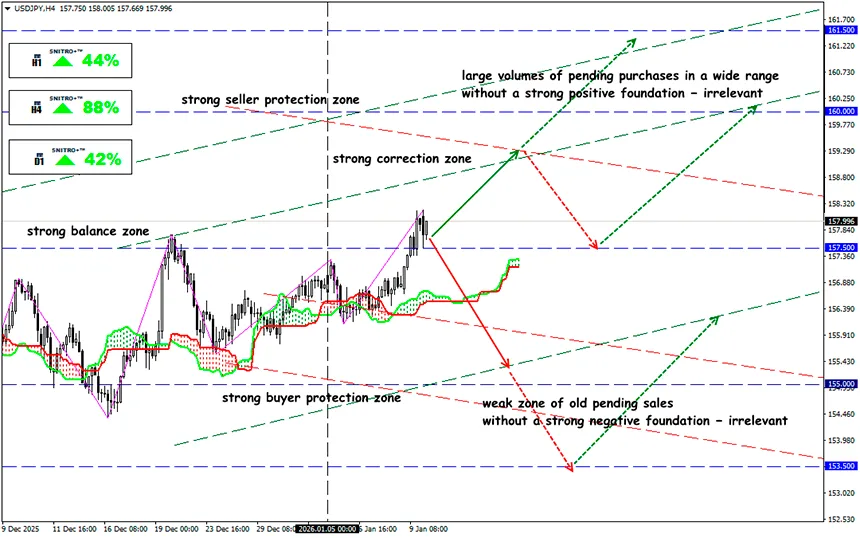
USD/JPY
Key zone: 157.00 - 158.50
Buy: 158.80 (on a confident breakout of the 158.50 level) ; target 160.50-161.00; StopLoss 158.20
Sell: 157.00 (on a pullback after retesting the 158.00 level) ; target 155.50-155.00; StopLoss 157.70
After the removal of Nicolás Maduro, Venezuela received a formal chance to emerge from a decade-long financial default. Previously, U.S. sanctions effectively deprived the country of access to basic debt instruments, including even the issuance of the most primitive bonds.
The country now faces one of the most complex sovereign debt restructurings in modern history, comparable in scale and difficulty to the Greek crisis of 2012.
The process is complicated by the fact that the United States is currently blocking any negotiations with creditors. Trump is obstructing any agreements, insisting on granting the U.S. absolute rights to use Venezuelan oil and other natural and financial resources, and is only willing to discuss the issue of debt owed to American companies. An additional source of uncertainty is the very vague outlook for the transition period under interim president Delcy Rodríguez.
Debt structure: who is owed and how much
The lack of transparent reporting remains the key problem. The Maduro regime failed to publish reliable data for years, so debt estimates are indicative in nature:
Total external debt is estimated at $150 billion or more, which is at least twice the current size of the country’s devastated economy.
- Before the 2017 default, Beijing provided Caracas with tens of billions of dollars, primarily through the China Development Bank (CDB), with repayment secured by oil supplies. The last tranche was issued in 2018. Outstanding loans are officially estimated at $15 billion; however, due to opacity, the real amount is likely several times higher.
- Bond debt of the government and the state oil company PDVSA amounts to around $60 billion in face value, while unpaid interest exceeds $100 billion.
- International arbitration claims related to assets (ConocoPhillips, ExxonMobil, gold mining companies) expropriated by the Maduro regime are estimated at approximately $20 billion.
Creditors are actively consolidating and seeking experienced negotiators. The Venezuela Creditor Committee, representing major bondholders including Fidelity, GMO, Morgan Stanley Investment Management, and VR Capital, succeeded in 2023 in extending the deadline for filing claims in U.S. courts until 2028. However, under current political conditions (Trump and company), all previous arrangements have effectively been annulled, and no new agreements are in sight.
How much will creditors recover?
Even under a relatively favorable scenario, in order to reduce Venezuela’s public debt to at least 80% of GDP, bondholders would have to accept a principal haircut of no less than 50%. This option looks milder than the Argentine experience, where recovery of around 30% of debt was considered a success.
The final volume of payments will depend on the condition of the economy and the oil sector. To restore the industry, Venezuela needs global oil prices near $80 per barrel to reach break-even. The current price level is critically negative for Venezuela — regardless of who controls exports and sells its oil.
The U.S. is effectively oriented toward a scenario of legal “liquidation” of creditors in order to restart the economy from a clean slate. As a working model, the experience of Iraq’s $130 billion debt restructuring is being used, where creditor losses exceeded 80%.
Creditors expect a comprehensive restructuring of bonds and bilateral loans, with payments directly linked to the recovery of oil production. Major oil companies are ready to convert arbitration claims into equity stakes in field development. However, any such arrangements imply direct negotiations with the Trump administration.
Given that overdue interest already accounts for 60–70% or more of the nominal value of Venezuelan bonds, some American investors allow for a recovery scenario of 60 cents or more per dollar of debt. Nevertheless, this approach appears excessively optimistic and lacks a solid fundamental basis.
For now, one thing is clear: neither oil nor potential gold production will save Venezuela.
So we act wisely and avoid unnecessary risks.
Profits to y’all!