









Huawei changes the rules of the game
How sanctions are accelerating the technological revolution
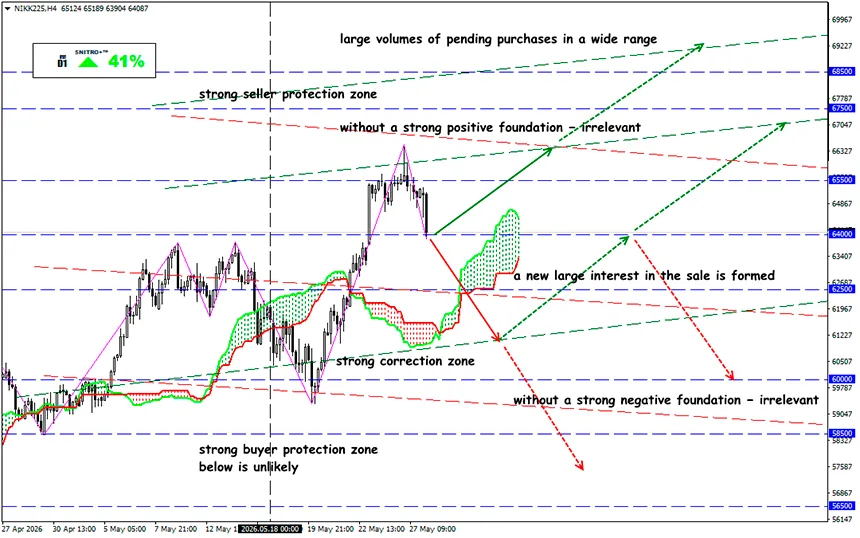
NIKK225
Key zone: 64,000 -65,000
Buy: 65,500 (on strong positive fundamentals); target 67,500; StopLoss 65,000
Sell: 63,500 (on a confident break above 64,000); target 61,500; StopLoss 64,000
When the traditional path becomes blocked, the market begins searching for alternatives. Sometimes it is restrictions themselves that become the driver of a technological leap. For decades, the semiconductor industry developed according to the logic of Moore’s Law: reducing transistor size ensured growth in chip performance. However, U.S. sanctions have significantly changed the rules of the game.
Restricting China’s access to equipment from the Dutch company ASML — primarily EUV lithography machines required for producing advanced semiconductors — has virtually eliminated the possibility of catching up with global leaders such as TSMC and Samsung through the classical model of technological scaling.
Huawei’s response was an attempt to change the very architectural logic of the industry’s development. The company introduced the Tau Scaling concept and the LogicFolding architecture.
Instead of the traditional race to reduce transistor size, Huawei proposes a different approach: transitioning from geometric scaling to temporal scaling. The Tau Scaling concept involves optimizing signal transmission speed within the chip architecture, while the practical implementation of the idea is LogicFolding — a system of vertical arrangement of computing blocks that reduces the length of critically important interconnections.
According to Huawei, the new architecture already provides a 53.5–55% increase in transistor density, a 41% improvement in energy efficiency, and a rise in operating frequency to 3.1 GHz. However, no independent verification of these figures has yet been conducted. Therefore, the current market reaction reflects more of a reassessment of future expectations than confirmation of an actual technological advantage.
Reminder:
For investors, this is not simply a new engineering development. Potentially, it is an attempt by China to change the economics of the semiconductor sector and redistribute capital within the Asian technology industry. Huawei aims to turn architectural efficiency into the key driver of performance, which could change the investment logic of the entire industry.
If the approach is successfully implemented, the market may revise valuations of manufacturers and the importance of access to advanced lithography.
The main potential beneficiaries of such a scenario:
- SMIC, which gains the opportunity to produce more competitive solutions even without access to EUV lithography;
- manufacturers of equipment for advanced packaging and interconnect technologies;
- Huawei itself with the Kirin and Ascend product lines.
At the same time, global competitors are already moving in a similar direction. Intel, TSMC, and AMD are actively investing in 3D packaging and hybrid chip interconnection methods.
The market reacted quickly to Huawei’s presentation. SMIC shares rose by approximately 7.6%, as investors saw an opportunity to reduce the technological gap without access to advanced lithography. This is particularly significant for the company: being limited to mature process technologies, it gains a chance to improve product competitiveness through architectural solutions.
An additional positive effect may benefit the segment of Asian suppliers of advanced packaging equipment and manufacturers of materials for interlayer interconnections. The HBM memory market, dominated by Samsung Electronics and SK Hynix, is of particular interest.
For Taiwan, the situation appears mixed. On one hand, TSMC retains a substantial technological advantage and continues moving toward real 1.4-nm process technologies. On the other hand, the very emergence of an alternative architectural model partially reduces the exclusive value of access to advanced lithography.
No less important is the question of the impact on the artificial intelligence market. Huawei has already announced plans to scale LogicFolding to the Ascend AI lineup by 2030, creating a local alternative to American GPUs. If China succeeds in at least partially reducing the technological gap in AI accelerators, this could affect Nvidia’s long-term valuations in the Asian region.
And what is the result?
Sanctions that were intended to slow the development of China’s semiconductor sector are beginning to function as a stimulus for the search for alternative architectural solutions. Historically, it has often been precisely such periods of restrictions that led to shifts in technological cycles.
Potential beneficiaries may include SMIC, the advanced packaging segment, and HBM memory manufacturers. The emergence of LogicFolding reduces the absolute monopolistic value of access to EUV lithography.
At this stage, what matters is not Huawei itself as much as the potential redistribution of capital across the entire Asian semiconductor sector. For now, the market is trading primarily on expectations rather than on confirmed technological results.
So we act wisely and avoid unnecessary risks.
Profits to y’all!