










Why Japan’s Currency Interventions Are Ceasing to Work
The Yen Is Losing Support
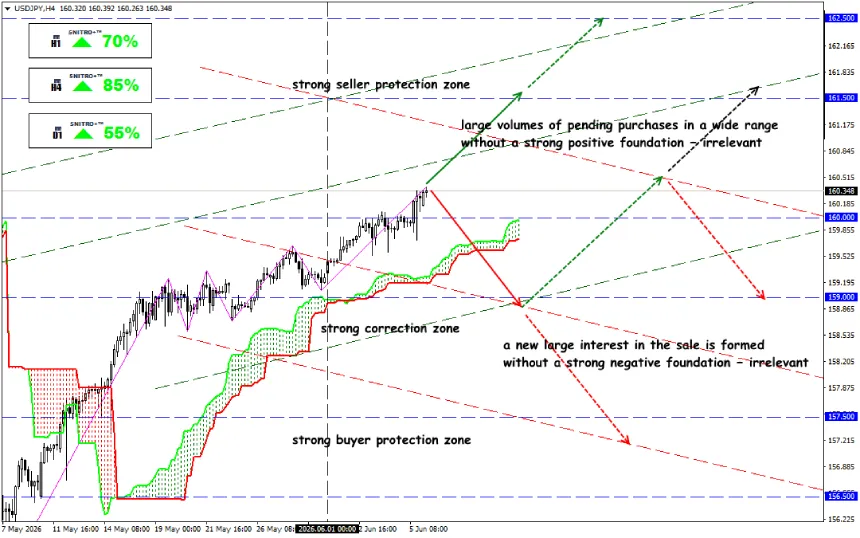
USD/JPY
Key zone: 159.50 - 160.50
Buy: 161.00 (on a pullback after retesting 160.00); target 162.50-163.50; StopLoss 160.40
Sell: 159.00 (on a confident break of 160.00); target 157.50-156.50; StopLoss 159.60
Japanese authorities have spent record amounts to support the national currency, but the effect of the interventions has proved limited. The volume of foreign securities in Japan’s international reserves fell by $75.6 billion — an amount that almost exactly matches the cost of the large-scale currency operations of recent months.
The main reason for pressure on the yen remains unchanged: the yield gap between two-year U.S. and Japanese government bonds continues to widen. Since the beginning of February, the spread has increased from 2.12% to 2.60%, preserving the attractiveness of dollar assets and encouraging positions against the Japanese currency.
Officials from Japan’s Ministry of Finance confirmed that currency interventions were one of the key factors behind the largest reduction in the country’s foreign exchange reserves in history.
Reminder:
To finance operations supporting the yen, Tokyo used investments in foreign securities, including U.S. Treasury bonds.
This approach is causing concern in Washington. The Trump administration is closely monitoring the condition of the U.S. debt market and is not interested in a large-scale sell-off of government bonds by the largest foreign holders.
Nevertheless, Japan carried out the largest currency intervention in its history, and under significantly different macroeconomic conditions than before.
The key feature of the 2026 situation is that financing was carried out neither through the state budget nor through the Bank of Japan. As before, a special government fund was used — the Foreign Exchange Fund Special Account.
Several factors were simultaneously putting pressure on the yen exchange rate:
- a new surge in global oil prices;
- escalation of the conflict in the Middle East;
- increased demand for the dollar as a safe-haven asset;
- rising costs for Japan’s energy imports;
- the continued higher yield of U.S. bonds.
Against this backdrop, the market was actively increasing short positions against the Japanese currency. According to Reuters estimates, the volume of speculative shorts approached $9 billion.
- Washington has so far shown no open dissatisfaction with Tokyo’s actions. U.S. Treasury Secretary Scott Bessent publicly expressed support for Bank of Japan Governor Kazuo Ueda, effectively making it clear that the United States expects further interest-rate increases in Japan.
- As of the end of May, Japan’s international reserves had fallen to $1.09 trillion. Despite the decline, this amount remains sufficient to conduct new interventions if necessary.
- Foreign currency deposits, which can also be used as a source of financing, remained almost unchanged at $162 billion.
- The sale of U.S. government bonds is not yet viewed as a critical threat to the market. More serious consequences would arise in the event of a large-scale sell-off of long-term 10-year Treasuries, which could disrupt the balance of supply and demand in the U.S. government debt market.
- In effect, Japanese authorities acknowledge that further reductions in holdings of U.S. bonds are becoming not only a matter of currency policy, but also a factor of global financial stability.
Market participants are paying additional attention to the Bank of Japan meeting scheduled for June 15–16. The issue of further interest-rate increases is expected to be discussed.
At the same time, the market estimates the probability of policy tightening in June at around 92%, yet the yen exchange rate continues to remain near levels that had previously already prompted currency interventions.
In addition, at the end of June, the U.S. Treasury Department will publish its next semiannual report on foreign exchange policy. Japan remains on the list of ten countries under enhanced monitoring by Washington.
And what is the result?
The main conclusion is that the effectiveness of currency interventions is gradually declining.
Additional pressure on the Japanese currency is coming from the U.S. and Israeli conflict with Iran. Japan is almost entirely dependent on energy imports, and more than 95% of its oil supplies come from Middle Eastern countries.
Rising oil prices automatically increase the Japanese economy’s need for dollars to pay for imports, intensifying pressure on the national currency.
After spending ¥11.7 trillion, the market returned fairly quickly to the levels that had previously forced the authorities to intervene. This indicates that fundamental capital flows remain significantly stronger than direct government action.
For the market, this is an important signal. Investors have seen that even interventions worth around $73 billion were unable to change the long-term trend of yen weakening.
For Japan’s Ministry of Finance, this creates a serious problem: each subsequent round of support for the national currency requires an ever larger amount of capital, while the effectiveness of such measures is gradually declining.
So we act wisely and avoid unnecessary risks.
Profits to y’all!