










The Dollar on a wave of illusions
The rise of the greenback is unreliable
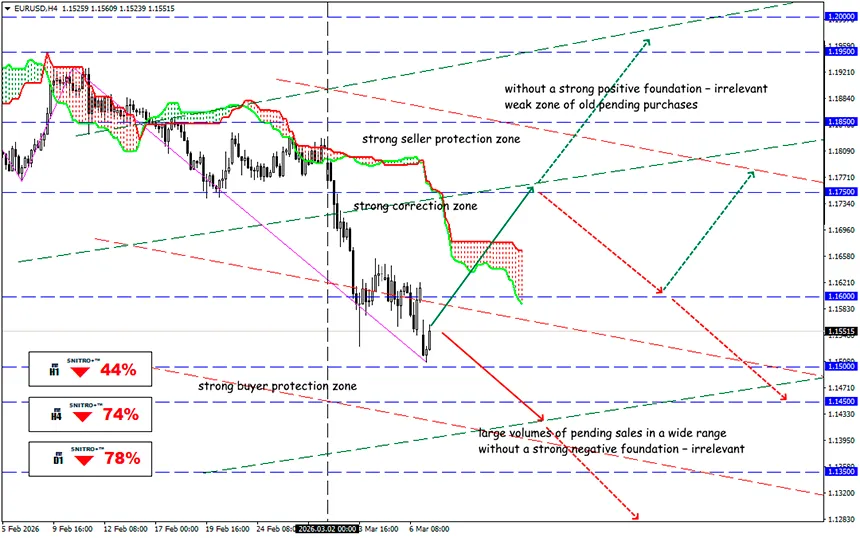
EUR/USD
Key zone: 1.1500 - 1.1600
Buy: 1.1620 (on a confident breakout of 1.1550) ; target 1.1750-1.1800; StopLoss 1.1550
Sell: 1.1500 (on strong negative fundamentals) ; target 1.1350-1.1300; StopLoss 1.1570
At the beginning of the week oil quotations tested the $120 per barrel level for the first time in four years. Despite the subsequent pullback caused by the easing of panic sentiment, this correction does not change the fundamental picture: the energy market still lacks stable prerequisites for normalization.
Against this background the dollar is still demonstrating resilience. However, the current rise of the American currency largely relies exclusively on the geopolitical factor rather than on macroeconomic foundations.
The military conflict in the Persian Gulf area is gradually taking on a protracted character. A rapid and convenient change of power in Iran for Washington is not yet visible, while the intensity of mutual strikes continues to increase. At the same time energy companies have begun suspending production amid the de facto halt of shipping through the Strait of Hormuz.
It is precisely this factor that largely explains the relative stability of the dollar: the largest industrial economies — Japan, South Korea, China, India and the entire European Union — critically depend on imports of energy resources.
The sharp rise in oil prices has already provoked a large-scale shift of capital into safe-haven assets, among which the dollar still remains. However, there are currently almost no fundamental economic grounds for a long-term strengthening of the American currency.
Nevertheless, CFTC data record a sharp increase in demand for the dollar after the beginning of the bombing of Iran. The aggregate short position on USD against major global currencies immediately decreased by $6.7 billion — to the level of −$12.3 billion.
At the same time the state of the U.S. economy demonstrates predominantly negative dynamics. The only factor supporting demand for the dollar remains the acceleration of inflationary risks. They are intensifying due to the rise in import costs after the introduction of new tariffs by the Trump administration. Even the decisions of the U.S. Supreme Court that limited part of these initiatives do not change the situation in the short term.
Additional pressure is created by rising oil quotations, which strengthen inflation expectations. Trump himself was forced to comment on the situation in his usual manner, stating that his actions would allow the market to stabilize.
According to the president, oil prices may decline quickly after the elimination of the Iranian nuclear threat. However, it remains unclear what time horizon he considers “short-term” and how exactly the United States plans to achieve these goals without a large-scale ground operation.
An additional indicator of rising inflation expectations was the dynamics of yields on five-year inflation-protected TIPS bonds, which by the close of Friday reached annual highs.
Macroeconomic statistics also strengthen alarming signals. The latest Nonfarm Payrolls report showed clear signs of cooling in the labor market.
In February, instead of the expected increase of employment by 59 thousand, the economy lost 92 thousand jobs. Moreover, the data for the previous two months were revised downward by another 69 thousand.
The next Federal Reserve meeting is scheduled for March 18, and the regulator will find itself in an extremely difficult situation. On the one hand, the deterioration of the labor market signals the risk of recession. On the other hand, the growth of inflation expectations limits the room for easing monetary policy.
For the Fed this is one of the most unfavorable macroeconomic scenarios.
And what is the result?
In the short term the dollar retains support thanks to its status as a safe-haven asset amid the military conflict. However, this factor is largely emotional in nature and is not supported by stable economic drivers. The longer the military confrontation continues without clear signs of its completion, the higher the probability of growing turbulence in global financial markets, and the more unstable the current dynamics of the American currency may become.
So we act wisely and avoid unnecessary risks.
Profits to y’all!