










Prices are falling, but the risk remains
How politicians are killing the oil market
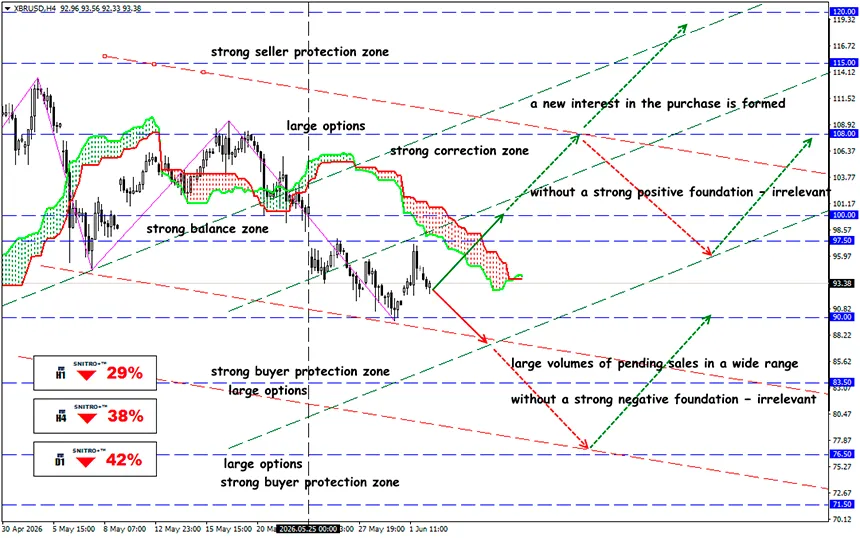
XBR/USD
Key zone: 90.00 - 95.00
Buy: 97.50 (on a strong positive foundation); target 100.00-108.50; StopLoss 96.80
Sell: 90.00 (on a pullback following a retest of 93.50); target 83.50-80.00; StopLoss 90.70
Oil prices are declining amid uncertainty surrounding negotiations between the United States and Iran. The escalation of hostilities following the Israeli-Lebanese talks in Washington on Friday under U.S. mediation has weakened hopes that Washington and Tehran are moving closer to extending the ceasefire agreement.
A possible easing of tensions between Israel and Lebanon has provided some relief in the context of the Middle East conflict. However, the Strait of Hormuz remains closed, and there are virtually no realistic paths toward its rapid reopening.
Asia remains the most vulnerable region, as before the crisis it consumed around 80% of the oil transported through the Strait of Hormuz. The scale of lost supply volumes significantly exceeds the additional volumes that Asia has been able to attract from the United States, South America, and Africa. Even the current consumption deficit cannot be fully compensated, let alone the rebuilding of inventories.
Let us recall:
In May, the United States shipped more than 63 million barrels of oil to Asia — a monthly record. However, on a daily basis this amounted to 2.05 million barrels per day, slightly below the peak levels reached in June 2023. Nevertheless, shipment volumes continue to grow. According to Kpler, U.S. exports to Asia will exceed 2.32 million bpd in June and 3.07 million bpd in July.
- Some Middle Eastern exporters, including Saudi Arabia and the UAE, have been able to reroute part of their volumes through ports located outside the Strait. However, no less than 10 million bpd remain unavailable to the global market.
- A deficit of around 5 million bpd is forcing Asian refineries into difficult choices. So far, they have maintained operations by relying on commercial inventories and, in some cases, strategic reserves, while simultaneously reducing refining volumes.
- The margin of safety is shrinking — the crisis could spiral out of control.
- Political pressure is increasing in the United States: politicians from both parties, focused on domestic issues, are beginning to oppose record oil and fuel exports, mistakenly believing that restricting overseas supplies will help reduce gasoline prices at home.
- The only reason people may have the illusion that the world has adapted to reduced supplies is the burning of reserves. Trump's nervousness is a consequence of problems with oil stockpiles (SPR), which he is actively drawing down to maintain fuel prices at levels comfortable for consumers. Iran has identified this pressure point very precisely and is methodically exploiting it. Trump appears weaker with each passing day.
If the Strait of Hormuz does not resume stable operations in the coming weeks, global petroleum product prices will rise again until higher prices eventually lead to demand destruction. The consequences of the crisis are likely to be distributed unevenly. Some regions may be able to maintain normal production volumes, while others could face acute fuel shortages.
There is an alternative scenario in which the United States and Iran suddenly reach an agreement on all issues, including the nuclear dispute and the reopening of the Strait of Hormuz, leading to a sharp decline in prices toward $70. However, we do not recommend relying on such an outcome. Stable peace in the Middle East remains a very distant prospect.
So we act wisely and avoid unnecessary risks.
Profits to y’all!