










Oil awaits a breakout
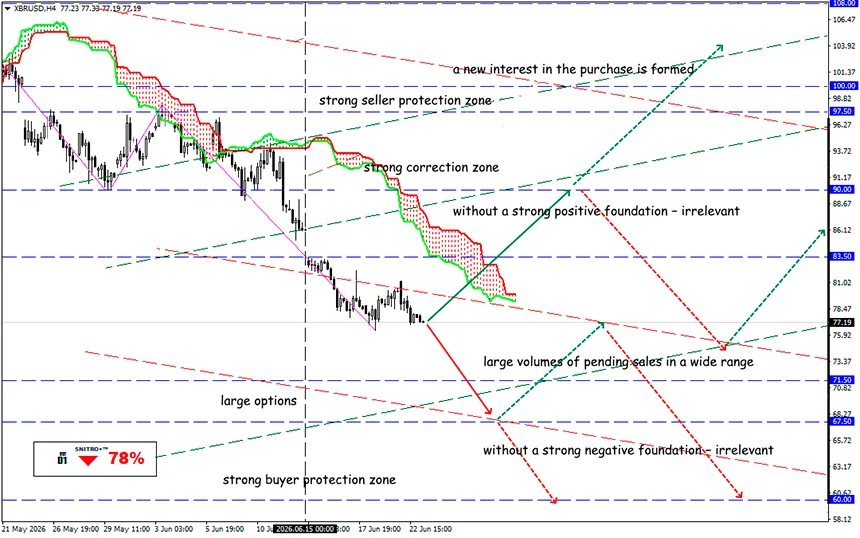
The Market does not believe in a lasting peace
XBR/USD
Key zone: 76.50 - 80.00
Buy: 81.50 (on strong positive fundamentals); target 83.50-87.50; StopLoss 80.80
Sell: 75.00 (on a decisive break above 76.50); target 73.50-71.50; StopLoss 75.70
The oil market continues to decline as the geopolitical risk premium shrinks, despite the partial resumption of traffic through the Strait of Hormuz. Investors are gradually abandoning their initial optimism surrounding negotiations between the United States and Iran and doubt that the newly opened diplomatic window will be able to ensure the long-term stability of one of the world's most important energy routes.
The Middle East conflict has long ceased to be solely a supply issue. Its consequences are beginning to affect global demand, particularly in countries and regions that are most sensitive to rising transportation costs, higher industrial production expenses, and increasing refining costs.
Reminder:
Brent crude futures fell 1.85% to $76.76 per barrel, while U.S. WTI declined 1.74% to $72.74 per barrel. The decline extended Monday's losses, when prices dropped by more than 3% following Washington's decision to grant Iran a 60-day sanctions waiver. Additional pressure came from reports of a temporary pause in hostilities in Lebanon.
The temporary easing of sanctions is expected to allow Tehran to continue exporting oil and related products to international markets during the negotiation process. This provides Iran with short-term economic relief while the parties attempt to transform last week's memorandum of understanding into a comprehensive long-term agreement.
In addition to restoring the full operation of the Strait of Hormuz, the parties continue to discuss issues related to international nuclear inspections and access to previously frozen Iranian assets.
Factors currently determining market dynamics:
- Supply risks remain the primary driver. According to monitoring data, two crude oil tankers carrying a combined volume of approximately 2 million barrels passed through the Strait of Hormuz on Monday. Market participants view this as a signal of a gradual recovery in logistics and confirmation of diplomatic progress.
- Rising transportation volumes continue to pressure prices. The market is likely to maintain a predominantly bearish sentiment until clearer signals emerge regarding the future balance between supply and demand.
- U.S. inventories remain an additional factor. Preliminary data indicate that the U.S. Strategic Petroleum Reserve has fallen to 331.2 million barrels, the lowest level since June 1983. This significantly limits Washington's ability to respond quickly to new supply shocks.
- The IEA has downgraded its global demand outlook. In its latest monthly report, the agency reduced its forecast for global oil demand growth in 2026 to 1.1 million barrels per day, 700,000 barrels lower than its previous estimate. During the second quarter, consumption declined by 5 million barrels per day amid high fuel prices and shortages of refined petroleum products.
A separate issue remains the lack of full transparency regarding the actual supply deficit. During the closure of the Strait of Hormuz, some crude continued to be exported through unofficial routes along the coast of Oman, meaning that the true volume of lost supply remains a matter of debate.
Nevertheless, factors supporting further price declines currently appear more significant.
- Non-OPEC+ countries are actively increasing production. South America, Canada, and the United States are ramping up output in an attempt to compensate for supply shortages. The United States has become the world's largest oil exporter for the first time.
- Accumulated oil volumes will return to the market. Significant quantities of crude currently stored temporarily aboard tankers will gradually enter the global supply system once shipping normalizes.
- Iran will be able to increase production. If the sanctions relief outlined in the memorandum is fully implemented, Tehran will gain the opportunity to substantially expand exports.
- OPEC+ may shift toward a battle for market share. As supplies recover, alliance members will likely have to increase production to maintain their positions in the global market.
The restoration of full operations through the Strait of Hormuz could gradually rebalance supply and demand, provided the region avoids new force majeure events. However, the market is unlikely to move smoothly from a supply deficit to an oversupply environment.
And what is the result?
Market skepticism has not disappeared. Trump has already warned that he is prepared to take tough measures if Iran fails to comply with the agreements reached. In turn, representatives of Tehran disputed U.S. Vice President J.D. Vance's statement that Iran had agreed to once again allow international nuclear inspectors into the country.
Over the coming months, the oil market is likely to remain highly unstable. Against the backdrop of significant depletion of commercial inventories, investor sensitivity to any geopolitical developments remains exceptionally high.
Any new military or diplomatic risk — from the collapse of the Swiss agreements on Iran to tough statements following international summits or new incidents in the Persian Gulf — could instantly alter market sentiment and restore demand for a risk premium.
Should such scenarios materialize, an impulsive breakout above the current trading range could quickly lift Brent prices into the $86–88 per barrel area and WTI prices toward $81–83 per barrel.
So we act wisely and avoid unnecessary risks.
Profits to y’all!