










No bets against the dollar
Why currency interventions no longer work
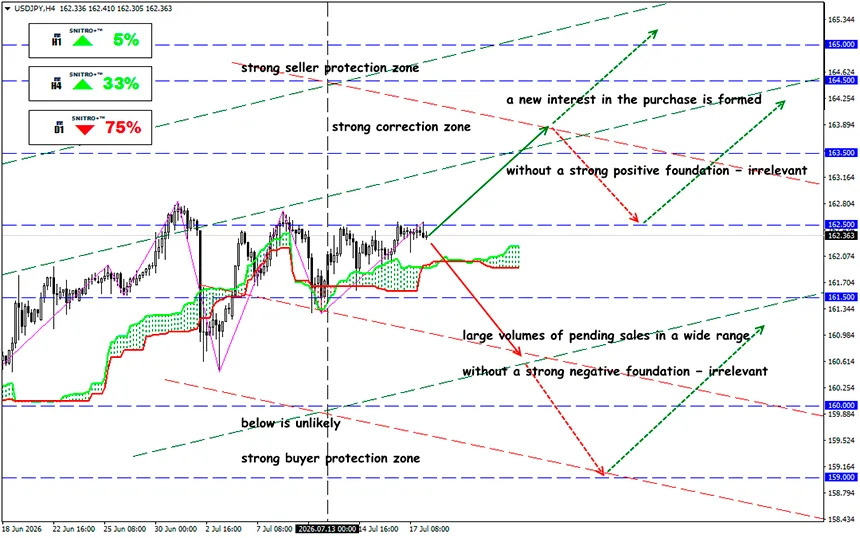
USD/JPY
Key zone: 162.00 - 162.80
Buy: 163.00 (on a pullback after retesting 162.50) ; target 164.50-165.00; StopLoss 162.30
Sell: 161.50 (on strong negative fundamentals) ; target 160.00-159.50; StopLoss 162.20
The U.S. dollar has managed to recover part of its lost ground amid deteriorating global risk appetite and hawkish signals from FOMC officials. The market has once again become convinced that the Federal Reserve is prepared to maintain—or even tighten—its monetary policy if inflation fails to continue moving toward the 2% target. However, the latest escalation in the Middle East is making such a scenario increasingly difficult to predict.
Another source of support for the U.S. currency has been the sell-off in technology stocks. As uncertainty increases, investors are once again turning to the dollar as their primary safe-haven asset.
Although the futures market has abandoned expectations of a Federal Reserve rate hike in June, market participants still estimate the probability of additional monetary tightening in 2026 at roughly 81%. At the same time, any further rise in oil prices could intensify inflationary pressure and bring forward a more active response from the Federal Reserve, providing additional support for the dollar.
Reminder:
Eight consecutive months of retail sales growth in the United States continue to confirm the resilience of the U.S. economy and the strength of consumer spending. In June, lower gasoline and natural gas prices provided additional support for demand, although this effect is likely to be temporary. A renewed escalation of the conflict in the Middle East could alter this picture within the coming months.
Betting against the American consumer remains an extremely risky strategy.
- Corrective moves are becoming longer and more complex, yet the dollar continues to maintain control of the market. European currencies remain directionless, while the Japanese yen continues to face downward pressure. It appears that the dollar is calmly watching Europe and Japan spend their resources trying to stabilize their own currencies.
- Renewed dollar strength has once again pushed USD/JPY higher. In response, Japanese Finance Minister Satsuki Katayama returned to her familiar verbal interventions, stating that the government stands ready to take decisive action at any moment if necessary. These comments came ahead of an extended holiday weekend in Japan, when lower market liquidity traditionally makes currency intervention more effective.
- However, the market no longer views the yen solely as a reflection of U.S. dollar movements. The primary driver behind USD/JPY remains the structural weakness of Japan's economy and the yen itself. That is why even periods of weakness in the U.S. Dollar Index are accompanied only by limited pullbacks in the currency pair.
What does this mean?
Just a few months ago, markets expected at least one Bank of Japan rate hike before year-end. Those expectations have now weakened considerably. Weak domestic demand, pressure on real household incomes, and deteriorating macroeconomic indicators leave the BOJ with very little room for further monetary tightening.
At the same time, the carry trade strategy continues to gain momentum. Even if expectations regarding future Federal Reserve policy become less hawkish, Japan's funding costs remain so low that investors continue borrowing in yen and reallocating capital into higher-yielding U.S. dollar assets. This automatically supports demand for USD/JPY.
Against this backdrop, currency interventions no longer appear sufficient to stabilize the exchange rate. USD/JPY continues to have the potential to move toward the 170 area, supported by the performance of U.S. and Japanese equity markets, the persistent interest rate differential between the Federal Reserve and the Bank of Japan, and the behavior of the CNH/JPY exchange rate.
For the third consecutive week, market participants have attempted to establish a foothold above the 163 level, but so far without success. Nevertheless, the underlying market structure remains unchanged: even during declines in the U.S. Dollar Index, USD/JPY buyers continue using virtually every meaningful pullback as an opportunity to open new long positions.
Following the breakout above key resistance levels, the market has established a new correction zone that is simultaneously viewed as a buying area. The overall trading scenario remains unchanged: buying the dollar after structural corrective declines continues to be the preferred strategy. The market has not yet generated a full-fledged entry signal, but the overall fundamental backdrop continues to strongly support the bullish scenario.
So we act wisely and avoid unnecessary risks.
Profits to y’all!