










How the greenback fooled the market
Betting on a falling dollar no longer works
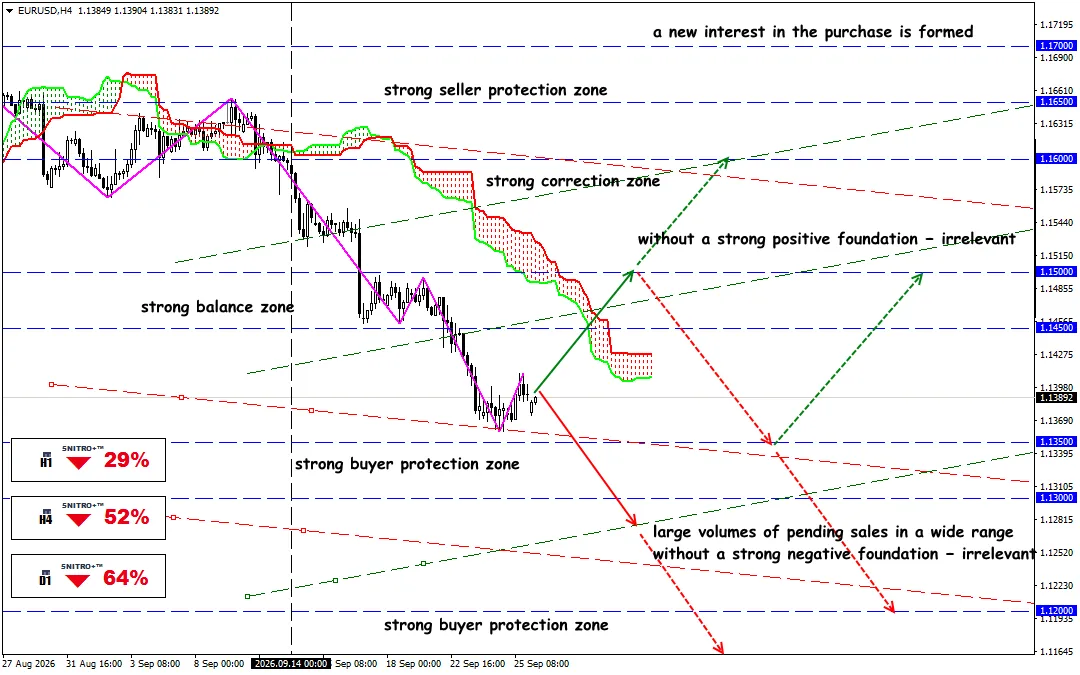
EUR/USD
Key zone: 1.1350 - 1.1400
Buy: 1.1450 (on a strong positive fundamental basis) ; target 1.1650; StopLoss 1.1380
Sell: 1.1300 (on a pullback following a retest of 1.1350) ; target 1.1150-1.1100; StopLoss 1.1370
A hawkish Fed, Treasury yields above 5%, and expensive oil are shifting the balance of power, but an overheated dollar already calls for cautious tactics. Until recently, gradual weakening remained the base-case scenario for the dollar. Now the market is being forced to reposition: the Fed raised rates, long-term U.S. yields reached multi-year highs, and expensive oil is once again creating inflationary risk.
But the dollar rally has its limits. DXY has already risen above 100.5, while the increase in long-term yields does not yet automatically mean the beginning of a multi-year USD bull cycle. For the next impulse, the market needs new confirmation — primarily from inflation, oil, and rate expectations.
A reminder:
The Fed changed the initial conditions: on September 16, it raised the target range for the federal funds rate by 25 bps, to 3.75–4.00%. The decision was unanimous, 12–0. The regulator noted resilient economic activity, real domestic spending, strong productivity growth, and capital investment. At the same time, inflation remains elevated.
Even more important is the updated FOMC forecast.
The median rate forecast for the end of 2026 rose from 3.8% in June to 4.1% in September. At the same time, the PCE inflation forecast for 2026 was raised from 3.6% to 3.7%, while core PCE was raised from 3.3% to 3.4%. The forecast for U.S. GDP growth in 2026 was also raised from 2.2% to 2.3%, while the unemployment forecast was lowered from 4.3% to 4.1%.
The USD does not need the U.S. economy to look perfect. It is enough for U.S. interest rates and Treasury yields to remain above relative expectations for other developed economies.
Now the Key Market for the Dollar Is Treasuries
The main source of the dollar’s current momentum lies not only in Fed decisions but also in the U.S. government debt market.
On September 24, the 10-year Treasury yield rose to 5.12%, while the 30-year yield reached 5.44%, its highest level since 2004. On September 25, the 10-year yield reached approximately 5.23%, while the 30-year yield was around 5.48%.
This is no longer a technical move in individual bonds.
The 10-year Treasury yield is a benchmark rate for an enormous range of financial assets — from mortgage lending to equity valuations and the cost of corporate financing.
The higher long-term yields rise, the tighter financial conditions become and the more attractive the dollar becomes relative to currencies with lower expected yields.
But there is an important caveat.
Yields can rise for different reasons. If the market sees a strong economy and a higher “higher for longer” rate path, this is relatively positive for the USD. If, however, yields rise mainly because of fiscal risks and an inflation premium, the signal for the dollar becomes less clear-cut.
Therefore, the US10Y level alone is not enough — it is necessary to understand the reason behind the move.
The second element of the dollar setup is energy.
Brent repeatedly rose above $100 per barrel in September. On September 10, the price reached $107.63 amid intensifying attacks on oil infrastructure and transportation routes in the Middle East.
Rising oil creates a paradoxical situation for the FX market.
That is why a geopolitical oil shock can simultaneously worsen the global growth outlook and support the USD.
If yields stabilize above 5%, the dollar receives support through the difference in the cost of capital. If US10Y returns below 5% amid declining inflation risks, part of the dollar premium may disappear.
What needs to be monitored?
DXY: The 100–100.5 zone is already ceasing to be merely a technical level. Consolidation above it would confirm that the dollar’s momentum remains intact, while a rapid return below it would be the first warning of weakening momentum.
US10Y: A sustained move above 5% supports the USD, especially if accompanied by rising short-term rates. A return below 5% would reduce the dollar’s fundamental advantage.
Brent: Oil above $100–105 maintains the inflation premium. Stabilization below $100 would reduce pressure on inflation expectations while simultaneously lowering the probability of further Fed tightening.
Rate expectations: The Fed’s median forecast for the end of 2026 now stands at 4.1%, so any renewed strengthening of expectations for the next rate hike would support the dollar. But if the market begins returning to a rate-cut scenario, the USD will lose one of its main drivers.
And What Is the Result?
The dollar is rising not because its structural problems have disappeared. Enormous government debt, the budget deficit, and the high cost of servicing the debt have not gone anywhere.
But the market is showing something important: long-term U.S. fiscal risk can simultaneously be negative for the dollar over a horizon of several years and a factor supporting it in the short term.
So we act wisely and avoid unnecessary risks.
Profits to y’all!