


France's debt bomb: storming the bastille is not on the agenda—yet
Can the euro survive another crisis?
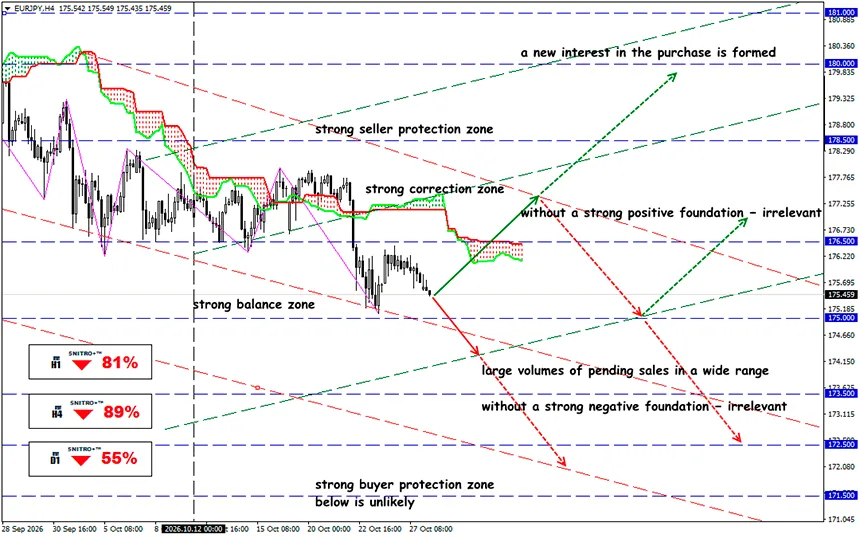
EUR/JPY
Key zone: 175.00 - 176.00
Buy: 176.50 (on strong positive fundamentals); target 178.50; StopLoss 175.80
Sell: 174.50 (on a decisive break above 175.00) ; target 172.50; StopLoss 175.20
OAT yields are approaching 5%, while the spread over German Bunds is widening. Investors are demanding a higher premium for French risk, testing the ECB's willingness to contain fragmentation in the sovereign debt market. Rising French borrowing costs are increasing pressure on European financial assets.
Investors are focusing less exclusively on overall interest rate levels and paying closer attention to Paris's ability to control its budget deficit and service government debt.
On October 28, the yield on 10-year French government bonds (OATs) reached approximately 4.965%, while comparable German Bunds traded around 3.382%. The difference was approximately 158.3 basis points. This gap indicates an increase in the premium investors demand for holding French debt rather than German securities.
A quick recap:
When OAT yields rise faster than Bund yields, this signals not merely tighter financial conditions across the Eurozone but an increase in risks specific to France. However, a widening spread alone does not mean a repeat of the 2010–2012 sovereign debt crisis. Such a scenario would require additional signs of systemic contagion: deteriorating conditions in other countries' markets, declining liquidity, difficulties placing new bond issues, and increasing stress in the banking sector.
For now, the pressure remains concentrated primarily on French assets. However, a domestic fiscal dispute could develop into a broader risk for the single currency.
At the same time, the French market has not yet shown a complete loss of access to financing. According to LSEG, France issued €13.25 billion in bonds at its October 15 auction, with an aggregate bid-to-cover ratio of 2.28. This indicates that investor demand remains intact, although the yields investors require continue to be a crucial indicator of the rising risk premium.
Domestic political instability is adding further pressure. Mass protests on October 17–18 heightened concerns about the prospects for implementing fiscal reforms. Potentially vulnerable stock market segments include domestically focused retailers, hospitality businesses, and banks, which are sensitive to economic activity, funding costs, and sovereign debt dynamics.
On October 23, Moody's maintained France's sovereign credit rating at Aa3, keeping the outlook negative. This decision eased concerns about an immediate downgrade but did not resolve the underlying problems.
Against this backdrop, the ECB's October 29 meeting is becoming a major event for financial markets. Three main scenarios are possible.
- Unchanged rates accompanied by hawkish rhetoric. If the ECB emphasizes persistent inflation risks and the need to maintain restrictive conditions, short-term European bond yields could receive support.
- Unchanged rates with an emphasis on financial stability. If the central bank focuses more on risks to the economy and sovereign debt markets, investors may scale back expectations of further monetary tightening.
- A signal of readiness to counter fragmentation. If the ECB confirms its willingness to use available instruments to prevent disruptions to monetary policy transmission, French bonds could gain support relative to German securities.
So What Is the Outcome?
For the euro, the decisive factor is not the mere occurrence of political protests or rising French bond yields, but their consequences for fiscal policy, borrowing costs, and financial system stability. If parliamentary disagreements delay the adoption of the budget or derail fiscal consolidation plans, investors may demand an additional risk premium even without another sovereign credit rating downgrade.
For EUR/JPY, the French debt issue could become particularly significant if rising European risks simultaneously trigger an unwinding of carry trades and increased demand for the yen as a safe-haven currency. However, this pair depends on more than developments in France: Bank of Japan decisions and policy signals, as well as changes in expectations for Japanese interest rates, could substantially alter its direction.
So we act wisely and avoid unnecessary risks.
Profits to y’all!