










Dangerous oil: the safety buffer is running out
The market is losing its backup routes
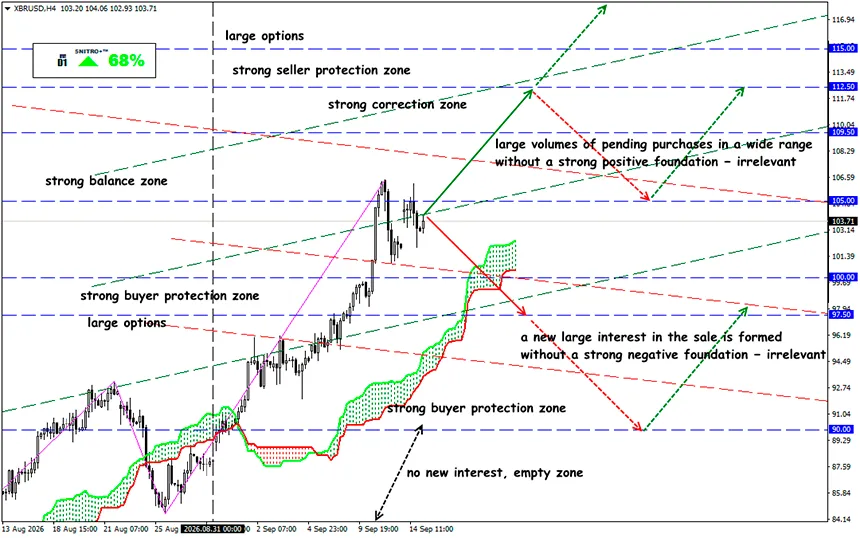
XBR/USD
Key zone: 101.50 - 105.00
Buy: 106.00 (on a confirmed break of 105.00); target 108.50-109.50; StopLoss 105.00
Sell: 100.00 (on strong negative fundamentals); target 96.50; StopLoss 101.00
The oil market has shifted from a supply deficit to a deficit of logistical resilience. Global inventories have been declining for the sixth consecutive month, Hormuz remains restricted, and the attack on Saudi Arabia’s East-West pipeline has knocked out the main bypass route. The question now is not where to get the oil, but how many days the market can withstand the next disruption.
The question now is not where to get the oil, but how many days the market can withstand the next disruption.
The global oil market has entered its most dangerous phase since the beginning of the conflict in the Middle East.
The problem is no longer limited to the number of barrels being produced. What matters is how much physical oil is available to consumers and how many backup routes remain in the event of another strike.
A reminder:
The IEA’s September report showed that observed global oil inventories fell by another 95 million barrels in August alone, or approximately 3.1 million bpd. Since the end of February, the cumulative decline has reached 507 million barrels, equivalent to an average draw of around 2.8 million bpd.
The volume of oil “in tankers on the water” fell by 65 million barrels — a direct consequence of attacks and problems with exports from the Middle East. Inventories in non-OECD countries declined by 52 million barrels, while inventories in OECD countries increased by 23 million. But even this increase is partly deceptive: government reserves in OECD countries simultaneously fell by 19 million barrels.
This is no longer ordinary inventory volatility — the market is consistently drawing down its own safety reserve while simultaneously losing the ability to adapt quickly.
As long as declining demand manages to offset the loss of supply, the market stabilizes. But if supply continues to fall faster than demand, Brent ceases to be merely a financial asset and becomes a mechanism for allocating scarce physical crude.
- The attack on Saudi Arabia’s East-West pipeline was a turning point. This oil pipeline, around 1,200 km long, connects the oil-producing regions in eastern Saudi Arabia with the port of Yanbu on the Red Sea. With Hormuz restricted, it allowed approximately 4–5 million bpd to bypass the strait. That is equivalent to around 4–5% of global oil supply. Following the September 10–11 attacks, Saudi Arabia halted this flow.
- Inventories in Yanbu are sufficient for approximately 5–7 days of exports. Additional volumes are stored at Egypt’s Ain Sokhna and Sidi Kerir terminals, but they too can extend the period of normal shipments only briefly. Meanwhile, repair estimates vary from 3 to 5–6 weeks; Saudi Aramco has not yet announced an official restoration timeline.
The market is losing its backup system — logistical risk is already being reflected in the physical movement of cargoes.
The planned meeting between Iran and the Persian Gulf states on a temporary shipping regime through Hormuz was postponed. As of September 15, there is no new sustainable diplomatic solution. This means the market cannot price in a rapid restoration of normal traffic through the strait.
So, What Does This Mean?
The oil market remains bullish now not because the world “does not have enough production.” It is becoming bullish because the world is running out of ways to quickly deliver the oil that already exists to where it is needed.
The price is acquiring a fundamental physical component:
less available oil + lower inventories + fewer routes + more time required for restoration = a higher rationing price.
That is precisely why the $110 zone no longer looks like an extreme level, but rather the nearest test of the market’s ability to absorb a new shortage. Traders now need to stop viewing East-West as a binary factor: operational/not operational.
If East-West restores even part of its capacity earlier than expected, Brent could experience a very sharp reversal. But if repairs drag on for 3–6 weeks, the market will be forced to compensate for the physical shortage through price.
At the current stage, however, the market has not yet reached full-scale demand destruction. Therefore, the short-term balance remains strongly bullish. But buying a vertical move after sharp daily spikes is already dangerous. $110–114 is the first important resistance zone. Consolidation above $113.50 will increase the probability of a move toward $120–126.
If another physical supply disruption occurs at the same time — damage to a terminal, another pipeline attack, or a further decline in traffic through Hormuz — the market could shift toward the $140–150 scenario.
So we act wisely and avoid unnecessary risks.
Profits to y’all!