










Bitcoin and Nasdaq: risk of a synchronous decline
Why BTC’s correlation with the stock market is dangerous
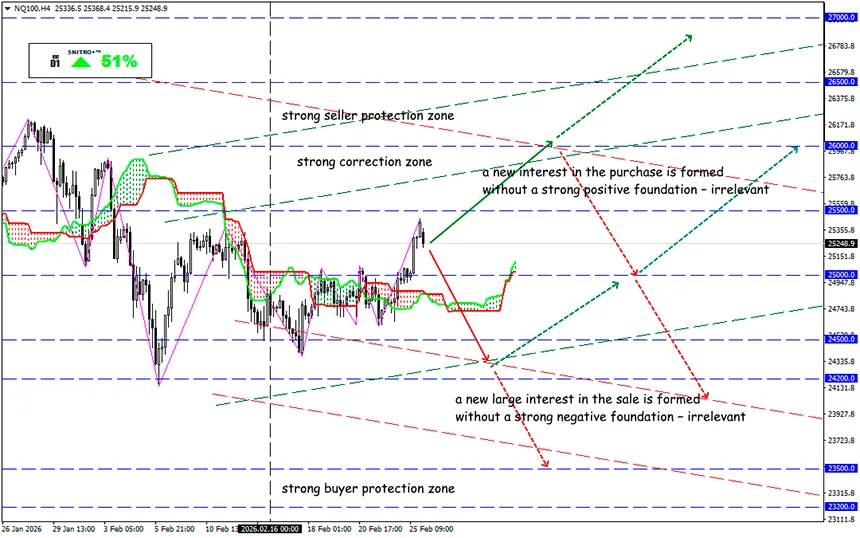
NQ100
Key zone: 25,000-25,500
Buy: 25,800(on a confident breakout of 25,500); target 26,500-27,200; StopLoss 25,200
Sell: 25,000(on strong negative fundamentals); target 24,200-23,500; StopLoss 25,500
In the cryptocurrency market, a stable opinion is forming: in the event of a deep correction in stock indices, the BTC price may decline to $50000, and if pressure intensifies — to $35000. Bitcoin’s correlation with equities has again reached levels comparable to the lows of 2022.
Historically, the key condition for the sustainable growth of digital assets was considered their independence from traditional financial markets. However, this model has changed. Starting approximately from 2019, the market increasingly perceives BTC not as an alternative asset, but as a high-volatility analogue of technology stocks.
Recall:
The relationship between BTC and stock indices such as S&P 500 and Nasdaq 100 remains a critically important factor for assessing its role in investor portfolios. The degree of this correlation determines whether bitcoin performs a diversification function or moves like a typical risk asset. In recent years, the dependence has gone from almost complete autonomy to periods of pronounced synchronization.
The current phase is characterized by high but unstable correlation:
- BTC’s correlation with the S&P 500 is about 0.28 in 2026 — lower than many traditional assets, but still significant
- correlation with individual tech stocks (for example Nvidia) reached 0.75
- the correlation of BTC’s 90-day volatility and the VIX index reached 0.88, indicating a strong connection with equity risk
BTC’s realized capitalization declined from the November peak of $1.12 trillion to $1.09 trillion. Over the past month, the indicator decreased by 2.26%, reflecting the continuing capital outflow.
The largest share of supply — 25.9% — falls on coins that have not moved for three to six months. Most of these positions were formed near price highs and remain at a loss.
Large investors avoid mass liquidation of positions; however, the inflow of new capital necessary for sustainable growth remains limited. Outflows from Bitcoin ETFs have continued for the fourth consecutive month.
Traditionally, it was considered that BTC’s dynamics follow the stock market: the cryptocurrency strengthens under conditions of a soft Federal Reserve policy and weakens when rates are tightened. However, over the past six months this dependence has been disrupted. Since the end of August, gold has risen by 51%, the S&P 500 has increased by 7%, while BTC has lost 43% of its value.
Potential easing of monetary policy may create conditions for accelerated recovery of digital assets, expanding the space for growth and reducing the current gap with stock indices.
What is the result?
Bitcoin can no longer be considered a fully autonomous asset — it has become part of the global financial system and increasingly moves synchronously with the technology sector, especially with the Nasdaq 100 index. At the same time, the cryptocurrency market amplifies the amplitude of movements of traditional assets, acting as a source of additional volatility.
Historical data show that during bear market periods, BTC declines usually exceeded Nasdaq losses by 2–4 times, although this gap is gradually narrowing due to institutional participation. Under current conditions, bitcoin demonstrates a closer relationship with technology stocks than with safe-haven assets. This means that a standard Nasdaq correction of 20–23% may lead to a BTC decline of another 25–40% from current levels, with the probability of such a scenario at about 20–25%.
About 150 days have passed since BTC formed its historical high — this is insufficient to complete a full cycle of long-term bottom formation, which usually takes about 250 days. Under these conditions, premature purchases carry elevated risk, while the strategic advantage remains on the side of investors willing to wait for confirmation of a sustainable reversal.
So we act wisely and avoid unnecessary risks.
Profits to y’all!