










Black friday: a trap for retailers
Which stocks will benefit from the consumer shopping frenzy?
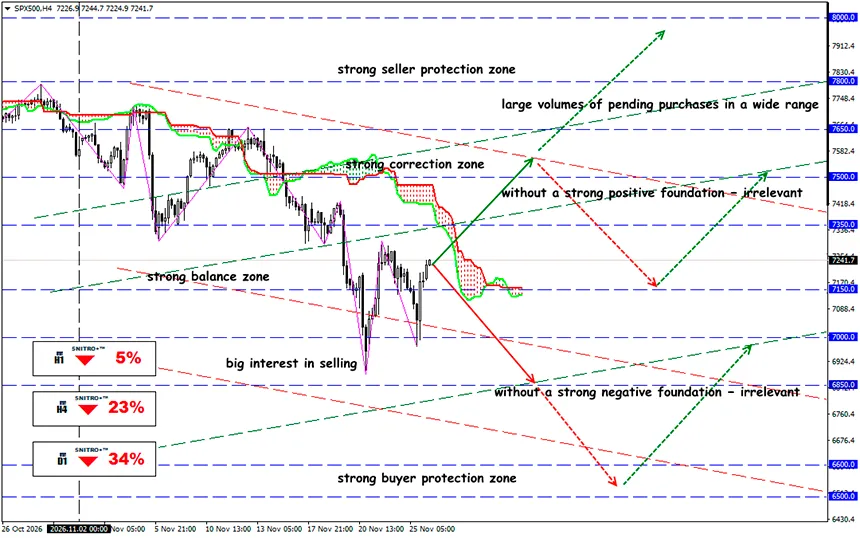
SP500
Key zone: 7,150 - 7,300
Buy: 7,350 (on a pullback following a retest of 7,250); target 7,500; StopLoss 7,280
Sell: 7,100 (against a strong negative fundamental backdrop); target 6,950-6,850; StopLoss 7,170
The holiday sales season will reveal how much inflation and high borrowing costs have changed Americans' shopping behavior. For investors, the determining factor will not be absolute sales volume but the ability of retail companies to maintain profitability amid aggressive discounts and changes in consumer spending patterns.
Black Friday and Cyber Monday will provide another test of the resilience of domestic demand following the release of quarterly earnings by the largest U.S. retailers. Companies capable of increasing sales without significantly eroding operating margins or accumulating inventories are of the greatest investment interest.
A reminder:
Black Friday kicks off tomorrow, November 27, while Cyber Monday falls on November 30. The initial holiday sales results will reach the market as November trading sessions give way to December. Consumer spending accounts for approximately two-thirds of U.S. GDP, so retail sales figures provide insight not only into corporate earnings prospects but also into the resilience of the U.S. economy as a whole.
However, record holiday sales do not guarantee a positive stock market reaction:
- Extensive use of discounts, credit cards, and installment payment plans can drive revenue growth without a comparable increase in profits.
- Bringing forward planned December purchases to late November may create the illusion of accelerating consumer demand without increasing overall seasonal spending.
Amazon's earnings report provided a telling example: despite a 12.1% increase in revenue, the company's profit declined by 2.4%. Excluding Amazon, the remaining companies in the sample recorded an 8.2% increase in profits alongside 6.9% revenue growth.
Nevertheless, the outlook for e-commerce remains favorable. According to Adobe Analytics' forecast, online sales in November and December could reach a record $275.1 billion, representing growth of 6.7%.
At the same time, the acceleration in holiday shopping is accompanied by a decline in the average transaction value. This trend may indicate changes in consumer habits:
- More active price comparisons and use of discount offers.
- Splitting large purchases into several smaller ones.
- Shifting toward more affordable products.
- Reallocating budgets toward everyday essentials.
- Using multiple retail platforms to optimize spending.
A decline in the average transaction value does not necessarily undermine retailers' financial performance. An increase in transaction volumes and higher conversion rates can offset the decline in individual purchase values, provided that acceptable profit margins are maintained.
Which Stocks Could Benefit From Black Friday?
- Amazon (AMZN);
- Shopify (SHOP);
- Walmart (WMT);
- Costco Wholesale (COST);
- Target (TGT);
- Home Depot (HD).
Investors may reallocate capital toward companies whose financial performance is driven by current consumer demand rather than projected returns on long-term AI investments.
In this context, Kroger (KR), Procter & Gamble (PG), Coca-Cola (KO), and PepsiCo (PEP) are of interest.
Discount retailers TJX Companies (TJX), Ross Stores (ROST), and Dollar General (DG) deserve particular attention. Growing consumer resistance to high prices guarantees these companies a competitive advantage even if overall consumption slows.
So What Is the Outcome?
The forecast of 6.7% growth in online holiday sales creates a favorable backdrop for e-commerce. However, the expected decline in the number of holiday shoppers, lower average transaction values, and rising consumer debt increase the risk of overestimating the actual strength of demand.
The main speculative risk following Black Friday and Cyber Monday is profit-taking on positive news. Even holiday sales exceeding forecasts could trigger a decline in stock prices if that scenario has already been priced in.
The key trading takeaway: priority should be given not to companies recording the highest holiday sales growth but to retailers demonstrating relative stock price strength and the ability to convert consumer demand into operating profit and free cash flow.
Sales records end when the promotional events are over, but the consequences of excessive discounts remain in financial statements.
So we act wisely and avoid unnecessary risks.
Profits to y’all!