










Why Japan and China Are Selling U.S. Debt
Asia Cuts Its Bet on the U.S.
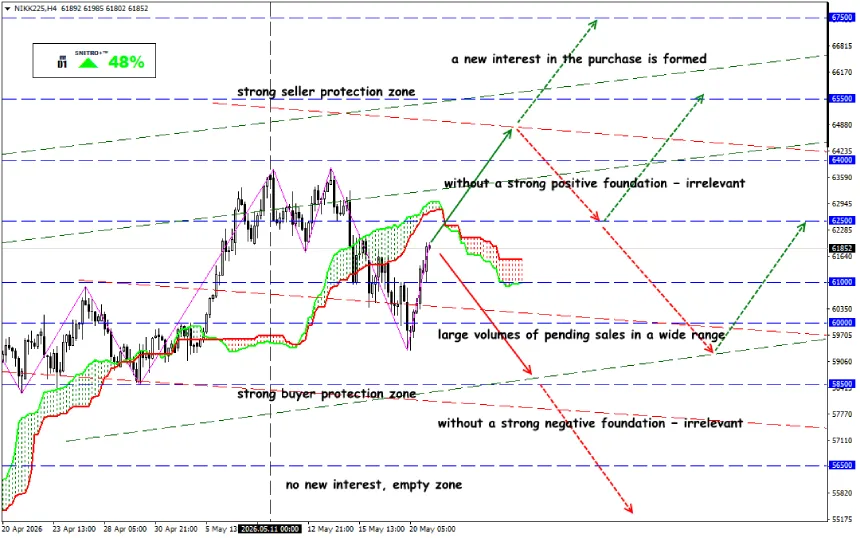
NIKK225
Key zone: 61,000 - 62,000
Buy: 62,500 (on strong positive fundamentals); target 64,000; StopLoss 62,000
Sell: 60,000 (on a confirmed break of 61,000); target 58,500-57,500; StopLoss 60,500
A signal has emerged in the U.S. debt market that investors cannot ignore: the largest foreign holders of U.S. Treasury bonds have begun actively reducing their positions. Against the backdrop of the Middle East conflict, central banks are being forced to sell part of their dollar reserves to support national currencies facing pressure from the energy crisis and rising import costs.
According to data from the U.S. Department of the Treasury, in March China reduced its holdings of U.S. government debt to $652.3 billion, approximately 6% below the February level and the lowest value since September 2008.
Japan reduced its portfolio by approximately $47 billion — to $1.191 trillion. Against this backdrop, Washington is closely monitoring whether Tokyo is using long-term Treasuries to finance currency interventions aimed at supporting the yen.
The sell-off in assets intensified after the start of the U.S.-Iran conflict, when oil prices surged sharply. Asian economies, heavily dependent on energy supplies from the Persian Gulf, faced the largest energy shock in recent decades. Under these conditions, authorities in several countries preferred to partially reduce dollar assets in order to finance currency interventions and stabilize domestic financial systems.
The key question for the market now is whether what is happening is a temporary adjustment to the crisis or the beginning of a long-term retreat by the largest U.S. creditors from American debt.
Reminder:
The Treasury bond market is already under serious pressure due to rising yields. The escalation of the Middle East conflict has intensified inflation risks and forced investors to demand a higher premium for holding U.S. debt.
Additional pressure also came from the sale of foreign assets: in March alone, foreign investors recorded losses totaling $142.1 billion on long-term Treasury securities.
China deserves special attention. Beijing began reducing positions in U.S. bonds approximately one month before Trump’s visit and has effectively cut the size of its portfolio nearly in half.
What is behind this strategy?
- Intensification of geopolitical confrontation between the U.S. and China.
- Concerns over sanctions risks and the potential freezing of reserves.
- Growth of the U.S. debt burden.
- Diversification of reserves into gold, commodity assets, and instruments outside the dollar system.
- Desire to reduce dependence on American financial infrastructure.
It is important to understand: what is happening cannot yet be called a panic sell-off. Consolidated statistics take into account not only net purchases and sales, but also portfolio revaluation and the specifics of holding assets through international financial centers.
For example, China is reducing the share of Treasuries not because it expects an immediate dollar crisis, but as part of a broader process — the gradual transition of the global financial system from the dominance of a single reserve currency toward a more fragmented model.
Nevertheless, this trend appears sustainable. China continues the consistent reduction of the share of U.S. debt amid geopolitical risks and a reserve diversification policy. Japan, in turn, is forced to balance between supporting the yen, the attractiveness of Treasury yields, and domestic liquidity needs.
The market is already pricing in a higher risk premium: the yield on 10-year Treasuries remains around 4.6%, while the total U.S. government debt is approaching $39 trillion.
And what is the result?
- A rise in 10-year Treasury yields above 4.7–5.0% could increase pressure on growth stocks and the crypto market.
- A decline in external demand for U.S. debt does not always immediately affect the dollar, but it increases volatility in the DXY index and intensifies uncertainty in global markets.
- Another surge in yields increases the risk of a correction in the Nasdaq and S&P 500, especially in the technology sector.
- For the crypto market, rising yields traditionally mean worsening risk appetite, requiring a more cautious approach to leverage usage.
- Increased attention should be paid to central bank activity in the gold market: demand growth for safe-haven assets may intensify.
If external demand for U.S. bonds continues to decline, the United States will have to retain investors through increasingly higher yields. This means additional pressure on growth stocks, real estate, and the digital asset market.
In such an environment, gold and defensive instruments may prove more resilient than the broader market. However, it is still premature to speak about a large-scale flight from the dollar.
So we act wisely and avoid unnecessary risks.
Profits to y’all!