










The U.S. labor market under Trump’s scenario
What NFP indicates in wartime conditions
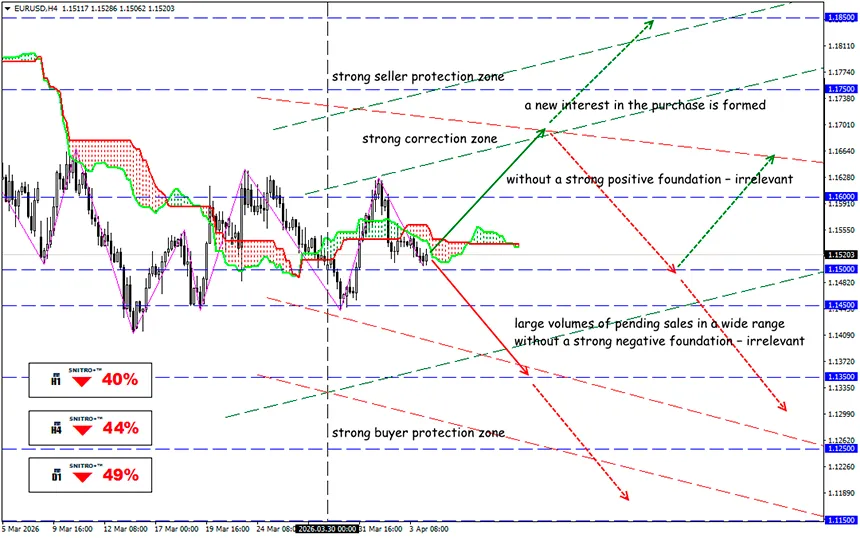
EUR/USD
Key zone: 1.1500 - 1.1600
Buy: 1.1650 (on strong positive fundamentals) ; target 1.1800-1.1850; StopLoss 1.1580
Sell: 1.1450 (after retesting the 1.1550 level) ; target 1.1350-1.1250; StopLoss 1.1520
Last week, the market faced an unusual situation: the release of a strong employment report triggered almost no reaction. However, the labor market is now becoming the key factor allowing Jerome Powell to complete his term as head of the Federal Reserve without serious doubts — inflation risks appear significantly more dangerous than the threat of a sharp deterioration in employment.
Signs of stagflation are becoming increasingly difficult to ignore and harder to conceal.
- The number of new jobs in March significantly exceeded expectations: +178K versus a forecast of +65K (previously −92K). This is the strongest increase since late 2024 — the “Biden era.”
- Revisions for previous months were moderately negative: — January: +160K (previously +126K) — February: −133K (previously −92K)
- The unemployment rate declined to 4.3% (expected 4.4%).
- Labor force participation fell to 61.9% (previously 62.0%).
- Wage growth slowed: −0.2% m/m and 3.5% y/y (previously 0.4% and 3.8%).
- The average workweek declined to 34.2 hours.
- The services PMI fell below 50 for the first time in three years.
The main issue is hidden deterioration. At first glance, the data appears strong, but the key negative factor is the decline in labor force participation. This indicator effectively “artificially” lowered the unemployment rate.
This implies:
- employment is growing faster than expected;
- unemployment is formally declining;
- risks of a sharp economic slowdown are not yet confirmed.
But if participation had not dropped from 62.5% to 61.9% over two months, the unemployment rate could have exceeded the critical 4.5% threshold.
For the Federal Reserve, the key benchmark remains the U3 unemployment rate. Its decline to 4.3% supports maintaining a hawkish stance. In other words:
- there is virtually no room for rate cuts;
- inflation risks dominate;
- some policymakers will insist on keeping rates at current levels.
Powell himself noted that the current situation allows for a compromise between inflation and the labor market, but emphasized that such a dilemma is not currently facing the regulator. In effect, the strong March report allowed the Fed to avoid one of its most difficult decisions.
The labor market is not only an economic issue but also a political one. For Trump, the current statistics look ambiguous: formally strong data is combined with a deteriorating structure.
Against this backdrop, pressure on the administration’s economic team is increasing, and personnel decisions appear likely. The figures clearly do not please Trump — he may well dismiss both the Secretary of Labor and the Secretary of Commerce.
At the same time, the White House’s main focus has shifted: the conflict with Iran, the situation around the Strait of Hormuz, and the need for rapid de-escalation for political stabilization. In effect, geopolitics now outweighs domestic economic concerns.
And what is the result?
Markets are waiting for signals of de-escalation rather than new macroeconomic data. For Trump, it is critically important to achieve at least the appearance of quick success — this is directly tied to political risks, including potential impeachment.
In the short term:
- investor attention is focused on the Middle East;
- the labor market has taken a back seat;
- liquidity remains reduced.
The main conclusion: the U.S. labor market still appears resilient, but its internal structure is already signaling a slowdown — and this hidden factor may become key in the coming months.
Today’s low trading activity (including due to closed European markets) has led to an accumulation of pending orders, but their execution during the current U.S. session remains uncertain.
So we act wisely and avoid unnecessary risks.
Profits to y’all!