








The EU is changing the rules of the game
Who will pay for the new trade war
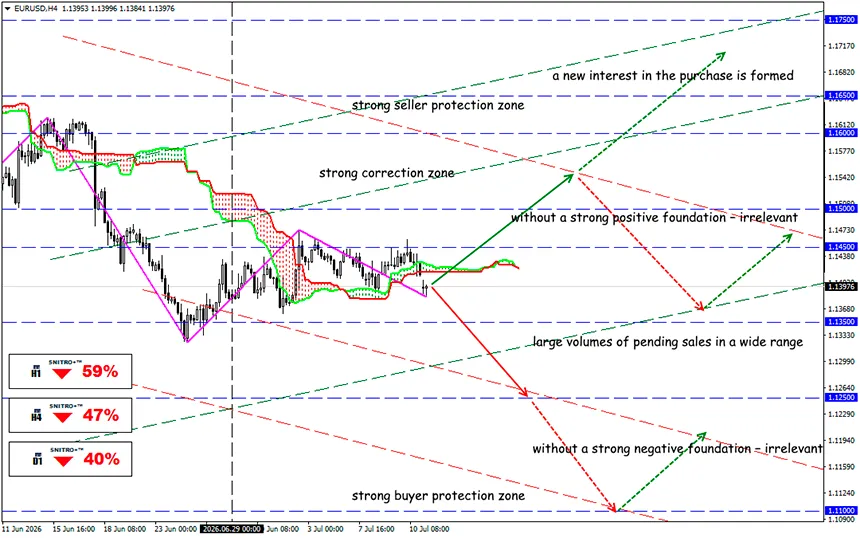
EUR/USD
Key zone: 1.1350 - 1.1450
Buy: 1.1500 (on a decisive break of 1.1450) ; target 1.1650; StopLoss 1.1440
Sell: 1.1350 (on strong negative fundamentals) ; target 1.1200-1.1150; StopLoss 1.1410
Europe is entering a new phase of its economic confrontation with China. Brussels is preparing to protect European industry from mounting pressure caused by Chinese imports. However, Beijing has repeatedly demonstrated its ability to retaliate asymmetrically—through restrictions on strategic raw materials, pressure on Europe's agricultural sector, and limitations on EU companies' access to the world's largest consumer market.
The trade war is gradually evolving beyond a dispute over tariffs. It is becoming a battle for technological leadership, manufacturing supply chains, and control over critical resources. That is precisely why the EU is launching a large-scale economic protection program centered on the European Competitiveness Fund (ECF).
Reminder:
The European Commission has proposed allocating €234 billion to the ECF as part of the EU's 2028–2034 budget. Together with the Horizon Europe program, total funding for strategic technologies, industrial development, and scientific research will reach €409 billion. The EU's new seven-year budget is estimated at nearly €2 trillion.
Officially, the Fund is scheduled to launch on January 1, 2028. However, if relations with China continue to deteriorate, Brussels could accelerate its implementation.
- The Fund is designed to protect European industries that are most dependent on Chinese technologies, industrial components, and supplies of critical raw materials.
- The EU's trade imbalance with China continues to widen rapidly. In 2025, European exports to China totaled €199.6 billion, while imports reached €559.4 billion. The trade deficit expanded to €359.8 billion—nearly €1 billion every single day.
- Over the past year, European exports to China declined by 6.5%, while imports from China increased by another 6.4%. Already in the first quarter of 2026, the trade deficit reached €98 billion—the highest quarterly level since 2022.
In 2025, nearly half of all rare earth metals imported by the EU came directly from China. Should Brussels introduce additional restrictions on Chinese manufacturers of electric vehicles, solar panels, or industrial equipment, Beijing could respond much more rapidly by targeting European industry.
Several sectors of the European economy remain particularly vulnerable.
- The automotive industry (Volkswagen, Mercedes-Benz, BMW), where a significant share of profits depends on the Chinese market and local manufacturing operations.
- Luxury goods producers (LVMH, Rémy Cointreau, Pernod Ricard, among others), for which China remains one of the largest consumer markets.
- The agricultural sector. Producers of pork, dairy products, and high value-added food products are likely to face the greatest risks, as they remain among the primary targets of potential Chinese countermeasures.
Growing trade restrictions are weakening the eurozone's export outlook and reducing industrial activity. If Europe's economy loses momentum faster than the U.S. economy, the probability of a more accommodative European Central Bank policy will increase, creating additional
fundamental pressure on the euro. As a result, EUR/USD could develop a long-term structural discount reflecting the weakness of European industry.
If both sides manage to agree on limited reciprocal restrictions, pricing commitments from Chinese manufacturers, and greater localization of production within Europe, a direct tariff war may be avoided. Nevertheless, competition for European subsidies, government investment, and strategic technology supply chains is likely to intensify.
What does this mean?
The greatest weakness of Europe's strategy is timing. China can introduce export restrictions almost immediately—within a matter of weeks. Europe's economic protection mechanism, however, is unlikely to become operational for at least another year and a half.
That is why financial markets are currently focusing less on the future ECF itself and more on Europe's ability to navigate the transition period without suffering significant economic damage.
At the same time, companies that are likely to become major recipients of future government investment are becoming increasingly attractive to investors.
For the foreign exchange market, the outlook for the euro remains moderately negative. Traders will increasingly have to evaluate European assets not only on corporate earnings but also on three key factors: exposure to Chinese revenues, dependence on Chinese components, and access to European government subsidies.
The real trade war has not yet been officially declared. But capital is already beginning to reposition itself as though it were inevitable.
So we act wisely and avoid unnecessary risks.
Profits to y’all!