










Testing Trump: the Fed makes its decision
Whose side are you on, Mr. Warsh?
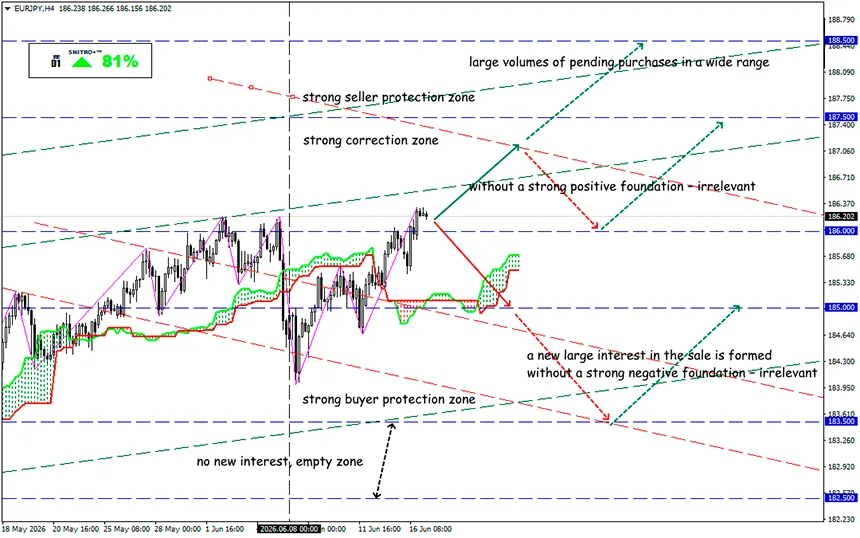
EUR/JPY
Key zone: 185.50 - 186.30
Buy: 186.50 (on strong positive fundamentals); target 187.50-188.20; StopLoss 186.00
Sell: 185.00 (on a pullback following a retest of 185.50) ; target 183.50; StopLoss 185.50
Today, the U.S. Federal Reserve is making its first interest-rate decision under its new Chair. The FOMC meeting is taking place under extremely challenging conditions: inflation is once again accelerating, while the labor market, although no longer appearing overheated, still shows no signs of significant deterioration.
The market finds itself in a situation where the regulator’s room for maneuver remains limited. Pressure from the White House persists, but economic realities require the Fed to maintain a firm and independent approach to monetary policy.
Reminder
All previous attempts by Trump to increase his influence over the Federal Reserve proved unsuccessful. The President failed to change the balance of power within the regulator: neither by influencing the reappointment process of regional Federal Reserve Bank leaders nor by securing a sufficient number of loyal candidates on the Board of Governors.
Political calls for lower interest rates continue, but within the FOMC a sufficiently influential group of financial community representatives has emerged that opposes premature policy easing and remains wary of any asymmetric decisions favoring lower borrowing costs.
Recent macroeconomic data also provide the regulator with no convincing justification for a rapid policy reversal.
Key indicators currently look as follows:
- In May, the Consumer Price Index (CPI) accelerated to 4.2% year-over-year, while core CPI stood at 2.9%.
- The latest available PCE data for April showed growth of 3.8% year-over-year, while core PCE reached 3.3%.
- The labor market remains resilient: nonfarm payrolls (NFP) increased by 172,000 jobs, the unemployment rate remained at 4.3%, and average hourly earnings rose by 3.4% year-over-year.
- Household inflation expectations, according to data from the Federal Reserve Bank of New York, remain elevated: the one-year forecast stands at 3.5%, while expectations regarding labor market conditions continue to deteriorate.
So far, the labor market gives the Fed no reason to rush into cutting interest rates. Consumer activity and the condition of the real economy present a mixed but far from disastrous picture.
At the same time, consumer confidence continues to deteriorate, fully consistent with the signals recorded in the April statement and the minutes of the regulator’s previous meeting.
A Rate Hike — Unlikely but Entirely Possible
The market still views maintaining current policy settings as the base-case scenario; however, the possibility of additional tightening can no longer be completely ignored.
The Fed’s April minutes showed that most participants remain concerned about the slowing progress toward returning inflation to the 2% target. Moreover, some Committee members explicitly acknowledged the possibility of another rate hike if persistent inflationary pressures continue.
If the Fed concludes that the renewed acceleration in CPI and PCE is driven not only by energy-related factors but is beginning to spread across a broader range of economic sectors, the probability of more aggressive action will increase substantially.
• Foreign Exchange Market
The priority remains buying the U.S. dollar against currencies of countries whose central banks have already approached the end of their tightening cycles or are beginning to transition toward monetary easing.
Interest-rate differentials continue to serve as one of the primary drivers of U.S. dollar strength.
• Stock Market
Preference should be given to two categories of assets:
- large technology companies with stable earnings and strong cash flows;
- sectors that are less sensitive to interest-rate dynamics.
These segments are better positioned to withstand a prolonged period of expensive money.
• Gold Market
Gold still retains potential for short-term speculative movements.
On one hand, the metal is supported by geopolitical tensions. On the other hand, high real interest rates and a strong dollar limit its upside potential.
Cryptocurrencies and the currencies of countries dependent on energy imports remain under the greatest pressure.
These instruments are the most sensitive both to a stronger dollar and to rising energy prices.
• And What Is the Result?
The primary focus of today’s meeting is not so much the rate decision itself but rather the first full-scale press conference of the new Fed Chair.
The market needs answers to several fundamental questions:
- How hawkish will his stance on inflation be?
- Is he prepared to accelerate the reduction of the Fed’s balance sheet?
- Does he intend to preserve policy continuity from recent years, or will he propose a new course?
For the U.S. central bank, continuity remains a critically important factor of credibility. Former Fed Chair Powell retains his seat on the Board of Governors, providing institutional stability and reducing the likelihood of abrupt shifts in rhetoric.
Furthermore, U.S. law significantly limits the possibility of political pressure on the Federal Reserve Chair. The Trump administration has few real instruments of influence, meaning Kevin Warsh has little incentive to demonstrate political loyalty.
That is precisely why there remains a high probability that the decision will be made solely on the basis of current economic conditions.
Given persistently elevated inflation, the most logical scenario remains leaving interest rates unchanged within the 3.50%–3.75% range.
So we act wisely and avoid unnecessary risks.
Profits to y’all!