










Oil as financial fuel for the yen
Can the commodity market save the japanese currency
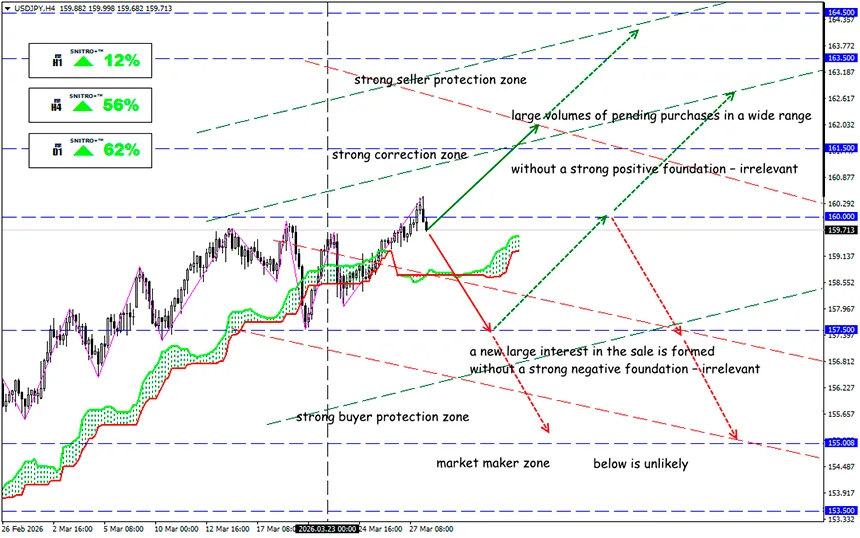
USD/JPY
Key zone: 158.50 - 161.00
Buy: 161.50 (on a decisive break of 160.50) ; target 163.50-164.50; StopLoss 160.80
Sell: 158.00 (on strong negative fundamentals) ; target 155.50; StopLoss 158.70
The yen strengthened after statements from Bank of Japan officials: the regulator made it clear that it is ready to maintain a tighter monetary policy amid the escalation of the conflict in the Middle East. Despite short-term risks for exporters, a rate hike is being viewed as a necessary step to fight inflation and maintain financial stability.
Let us recall:
Japan’s key problem is its strong dependence on energy imports. Any movement in oil prices is almost instantly reflected in the country’s currency and trade balance.
Due to rising energy prices amid the Middle East conflict, the government is considering the possibility of indirectly supporting the currency through the energy market. Although intervention in the energy derivatives market is extremely unusual for Japan, speculative trading in oil futures is now beginning to influence the Japanese yen exchange rate.
- Almost all of Japan’s oil demand is covered by imports, with more than 90% of supplies coming from Middle Eastern countries. Problems with logistics and rising global prices since the end of February have already led to higher costs for fuel, electricity, and food. In response, the government has begun releasing about 80 million barrels from strategic reserves.
- Rising oil prices increase inflation and at the same time raise the country’s need for U.S. dollars to pay for imports. This creates double pressure on the Japanese yen. If oil prices can be stabilized, pressure on the currency will decrease, and some speculative positions will begin to close.
The Japanese government may try to influence prices indirectly — for example, through operations in oil futures. The enormous size of the “paper” oil market, where derivatives trading significantly exceeds physical supply, theoretically allows prices to be influenced even by relatively small transactions.
One possible scenario is selling oil futures to cool prices, followed by gradually closing positions in small volumes. Such operations would most likely be carried out through financial institutions — just like traditional currency interventions.
For comparison: in April 2024, Japan already conducted a large-scale currency intervention worth about ¥5.9 trillion (approximately $37 billion), which allowed the exchange rate to be corrected by more than five figures. However, the authorities are unlikely to risk such volumes now.
So what is the result?
Speculators are a very nervous crowd. Sometimes, controlled panic created by government rumors about a possible intervention is enough — and this situation alone can support the yen. But intervention through the oil market is only possible under conditions of extremely high volatility — and for now it remains moderate.
At the same time, selling oil futures carries serious risks. If oil prices rise sharply, such trades could lead to significant losses. In case of failure, this could not only increase pressure on the currency but also undermine confidence in the government’s economic policy.
For now, everything will depend on two factors: how much oil prices rise and whether the Japanese yen can avoid a sharp weakening. If oil does not rise significantly above current levels and the exchange rate does not move far beyond the 160 per dollar mark, the market will most likely deal with speculators using traditional methods.
So we act wisely and avoid unnecessary risks.
Profits to y’all!