










IPO: a new stress test for wall street
SpaceX will test the market’s appetite for Future-Oriented Narratives
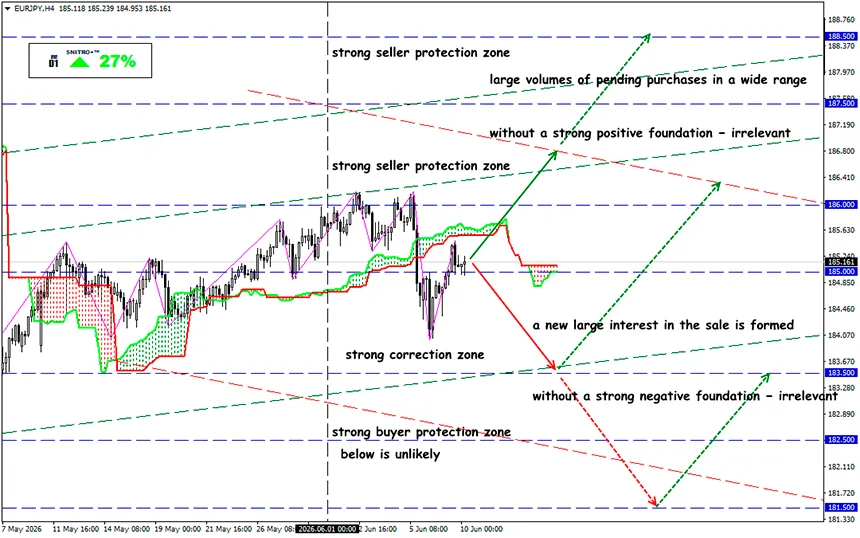
EUR/JPY
Key zone: 184.00 185.50
Buy: 186.00 - ; target 187.50-188.00; StopLoss 185.30
Sell: 183.80 (on a decisive break of 185.50) ; target 182.50-182.00; StopLoss 184.50
The autumn-summer IPO season could become one of the most revealing tests for the U.S. capital market. SpaceX, OpenAI, and Anthropic are simultaneously bringing to the public market the three most popular investment themes of recent years — artificial intelligence, space technology, and the infrastructure of the future.
The key question is not the quality of these companies, but whether the market is capable of justifying current valuations and absorbing such a concentration of large-scale capital demand within a single sector.
Reminder
An additional layer of intrigue comes from the history of relationships among the key players. Musk was among the founders of OpenAI in 2015 but left the company’s board of directors in 2018. In May 2026, he lost a legal dispute against the developer of ChatGPT, effectively removing one of the obstacles to OpenAI’s public listing.
Anthropic founder Dario Amodei left OpenAI in 2020 and created his own company just a year later. On June 1, Anthropic unexpectedly filed IPO documents. An OpenAI listing is also expected in the near future. The market expects both IPOs to take place in the fall.
Stock market history shows that companies going public later within the same investment wave often face less favorable conditions. Typically, the largest inflow of capital goes to the first and strongest representatives of a new sector, while later issuers must compete for investor attention against already partially exhausted demand.
SpaceX opens the season on Nasdaq this Friday, June 12.
The company's expected valuation may reach $1.77 trillion, while potential proceeds could amount to at least $75 billion. If underwriters exercise their over-allotment option, the total IPO size could increase to $86 billion.
Several aspects of the deal deserve special attention.
- The company has pre-set a fixed offering price of $135 per share. In effect, SpaceX has abandoned the traditional price-discovery process, demonstrating confidence in demand. The signal to the market is crystal clear: the issuer sets the terms, not investors. In other words, the message is "take it or leave it."
- The company’s financial results appear impressive. Revenue grew by 33% in 2025, reaching $18.67 billion.
- Starlink remains the primary source of income. Satellite internet generated approximately $11.4 billion in revenue and delivered $4.4 billion in operating profit.
- The space segment also maintains dominant positions. SpaceX controls more than 80% of the global launch market measured by payload mass delivered to orbit. The failure of Jeff Bezos’ Blue Origin project has only strengthened SpaceX’s position.
However, SpaceX’s investment profile changed significantly after the integration of xAI.
Previously, the market viewed the company primarily as a leader in the space industry. Now, a substantial portion of the investment story revolves around artificial intelligence.
This is where investors' main concerns are concentrated.
In 2025, xAI generated $3.2 billion in revenue but recorded a loss of $6.4 billion. During the first quarter of 2026, the company earned $818 million while simultaneously increasing losses by another $2.5 billion.
Its current spending pace is approximately $1 billion per month, mainly due to investments in computing infrastructure.
- To partially offset these expenses, SpaceX plans to monetize its own computing capacity. Under existing agreements, Anthropic is expected to pay approximately $1.25 billion per month for the use of the Colossus and Colossus II data centers in Tennessee through May 2029. Assuming, of course, that Musk does not change his mind and terminate the agreement with a competitor.
And what is the result?
The key issue (and risk!) of this IPO is the actual valuation of the business. With an expected market capitalization of $1.77 trillion and 2025 revenue of $18.67 billion, the price-to-sales ratio reaches 93.7x. For comparison, the average P/S ratio of S&P 500 companies stands at 3.38x, while Tesla trades at approximately 16.73x.
This is precisely why Musk’s critics consider the current valuation excessive and estimate the fair value of SpaceX at no more than $780 billion.
The company’s corporate structure is also facing serious criticism.
For example, the Danish pension fund AkademikerPension has already placed SpaceX on its blacklist, calling its governance model “critically dangerous” for minority shareholders. Investors are being offered Class A shares with one vote per share. Meanwhile, Elon Musk will retain control of 5.5 billion Class B shares, each carrying ten votes.
As a result, Musk will control approximately 94% of all voting shares and roughly 85% of total influence within the company. In other words, public investors provide the capital but have virtually no ability to influence strategic decisions.
The AI market remains another major source of uncertainty.
Businesses are still unable to objectively assess the long-term return on massive investments in AI infrastructure. At the same time, competition is intensifying from more affordable alternatives, including Chinese developments such as DeepSeek.
Pressure is also increasing from other market participants — Nvidia, Cohere, Reflection, and Mistral — all of which are actively developing alternatives to OpenAI and Anthropic products.
Ambitious narratives work well in private funding rounds, but they do not always withstand the test of the public market.
So we act wisely and avoid unnecessary risks.
Profits to y’all!