










Fatigue from geopolitics: risk is back in pricing
Markets return to pre-war reality
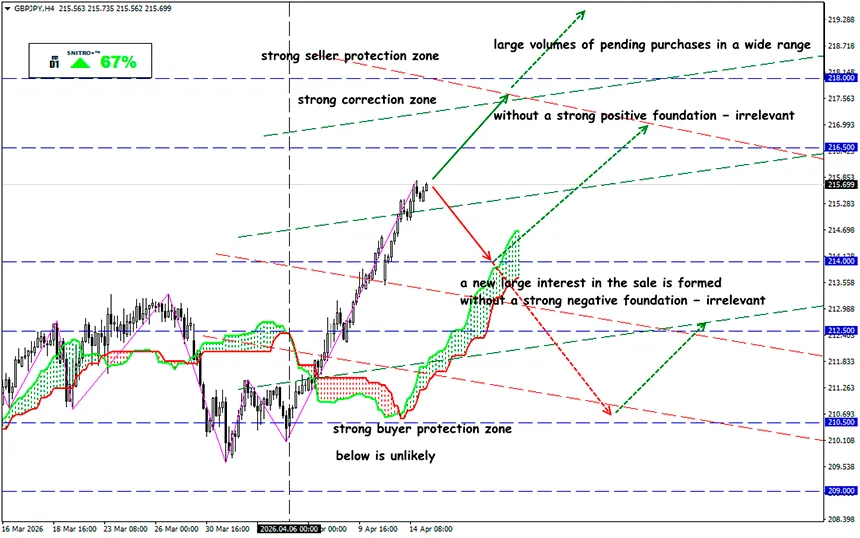
GBP/JPY
Key zone: 215.00- 216.00
Buy: 216.50 (on strong positive fundamentals); target 218.50; StopLoss 216.00
Sell: 216.00 (after retesting the 217 zone) ; target 214.50-213.50; StopLoss 216.50
Financial markets are showing a clear shift in the perception of geopolitical risks: participants are increasingly ignoring negative news and pricing in a de-escalation scenario. European currencies are confidently recovering March losses, the S&P 500 index and the British pound are already trading above levels recorded before the start of the Middle East conflict.
At the same time, the U.S. dollar is gradually losing its role as an unconditional safe-haven asset.
Trump, who is interested in rising equity indices, is making the strongest effort to end the conflict: he claims that Iran called him and wants to make a deal. Then he states that the right people in Tehran are not against returning to the negotiating table.
Pakistan and China are joining the process, while Tehran itself signals partial compromises have been reached. Against this backdrop, investors are selective: positive signals are amplified, negative ones are ignored.
- The U.S. equity market has recovered to pre-war levels on expectations of strong Q1 corporate earnings and depressed valuations. At the same time, market participants are effectively ignoring high Fed rates and stagflation risks.
- The oil market remains restrained: despite geopolitical risks, Brent is trading only about $30 above pre-conflict levels.
- According to Wall Street forecasts, S&P 500 EPS in Q1 will grow by 12.5% — the sixth consecutive quarter of double-digit growth. The share of companies with positive expectations may reach its highest level since 2021.
- Treasury yields are 35–40 bps higher, and traders have largely abandoned hopes that the Fed will cut rates in 2026. Conditions are much worse than at the end of February, yet this does not prevent the S&P 500 from rising.
- U.S. Treasury yields have risen by 35–40 bps, while expectations for rate cuts in 2026 have nearly disappeared. Although nominal Fed rates remain high, rising inflation reduces real bond yields, preventing policy from being considered excessively tight.
European currencies are also showing strength. The British pound has returned to pre-war levels, the Swiss franc and Swedish krona have approached them, and the Norwegian krone is ready to update highs since mid-2022.
At the same time, the energy factor is adjusting macroeconomic expectations.
ECB President Christine Lagarde noted that rising energy prices force a revision of the baseline scenario. However, the current situation does not yet require immediate rate hikes. Inflation in the eurozone already significantly exceeds the 2% target, but the regulator remains cautious.
The market is pricing in gradual tightening: two 0.25% hikes are expected during the year with about a 30% probability of a third move. At the same time, no significant changes are expected at the April 29–30 meeting.
The key driver of current dynamics is belief in de-escalation. Market participants see stabilization as more likely than a breakdown of the ceasefire or new strikes in the region. Even the blockade of the Strait of Hormuz is perceived as a less aggressive phase compared to direct military action.
The market is shifting from geopolitical fear mode to risk reassessment.
Against this backdrop, there is active unwinding of long USD positions, which had previously reached 14-month highs. Weakening demand for the U.S. currency supports gains in EUR and GBP, including cross rates. The yen remains the weak link: GBP/JPY is moving toward 18-year highs.
However, the sustainability of current optimism directly depends on actual developments in the conflict: in case of renewed escalation, the balance may shift quickly.
So we act wisely and avoid unnecessary risks.
Profits to y’all!