










The US labor market: weak, but still stable for now
What to expect from the non-farm payrolls report
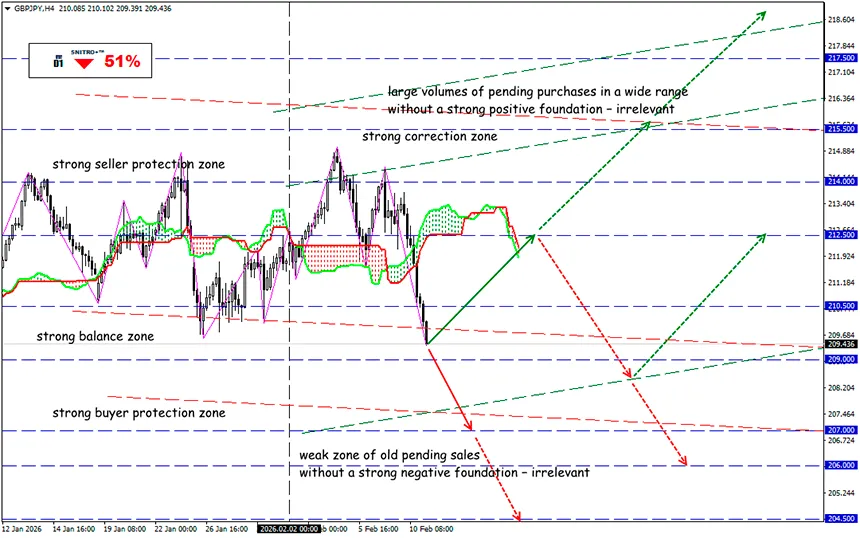
GBPJPY
Key zone: 209.00- 210.50
Buy: 211.00 (on a confident breakout of the 210 level); target 213.50; StopLoss 210.30
Sell: 208.50 (on strong negative fundamentals) ; target 206.00; StopLoss 209.20
The US labor market is demonstrating resilience only formally, while internal indicators increasingly point to structural conflicts.
Against the backdrop of current macroeconomic statistics and rising political risks, the labor market remains the key source of pressure on the Federal Reserve. A deterioration in employment indicators could accelerate the regulator’s shift toward monetary easing and trigger a cycle of interest rate cuts as early as summer.
This makes today’s NFP release one of the most sensitive events for financial markets.
Let us recall:
Previously, the dollar reacted negatively to weak December retail sales data, signaling a decline in the role of consumer demand in the economy by the end of the year. One of the core indicators of household activity showed a pronounced slowdown.
Consumers continue to face pressure from the high cost of living and remain concerned about the situation in the labor market. Inflation continues to erode purchasing power, while uncertainty in employment forces households to shift toward a more restrained spending model focused on essential goods.
Due to the postponement of the official BLS release, the ADP report was perceived by the market as the key preliminary benchmark. The latest data provide no grounds to expect a recovery in employment: the potential for acceleration in job creation remains extremely limited.
In January, employment growth in the US private sector turned out to be significantly below forecasts. Only 22 thousand new jobs were created — the worst result among all estimates collected by Bloomberg. In addition, November data were revised downward from 7.1 to 6.9 million, reinforcing the negative trend observed since October last year.
The most notable decline in job openings was recorded in professional and business services (-257 thousand), retail trade (-195 thousand), as well as in the financial sector and insurance (-120 thousand). Amid weakening demand for labor, hiring levels in December remained virtually unchanged at 5.3 million.
According to separate corporate statistics, January 2026 became a record month for announced layoffs since the 2009 crisis. The main reasons are economic uncertainty, contract expirations, and restructuring of business models. An additional factor is restrained hiring policy amid immigration restrictions, trade risks, and uncertainty related to the implementation of artificial intelligence.
Concerns are growing that AI itself is becoming one of the key drivers of changes in the mid-level job segment reflected in recent reports. At the same time, the BLS report on strikes indicates that their conclusion could add about 1.5 thousand jobs to January statistics.
As for expectations regarding today’s NFP, Goldman Sachs forecasts job growth of 45 thousand, which is below market consensus. The main argument in favor of a weak result remains the update of the statistical “birth-death” model, which traditionally has a significant impact on the final figures. At Wells Fargo, analysts note that the labor market has stabilized at low levels: the main contribution to growth came from education and healthcare, while employment in professional and business services continues to decline.
From Trump’s latest statements, the market highlights several key theses:
- The United States should have the lowest interest rates in the world;
- a 1% rate cut saves the economy about $600 billion and is potentially capable of eliminating the budget deficit;
- employment indicators remain “good” even after reductions in the public sector.
It creates the impression that Trump is already familiar with the NFP data and interprets them as positive within his own logic. However, the market does not share such optimism.
The Fed’s rhetoric remains restrained, but the vulnerability of the economy is increasingly concentrated precisely in the employment sphere. Any changes in expectations regarding wages, average workweek duration, and the number of job openings can directly affect the trajectory of monetary policy and global market expectations.
The short-term reaction to the NFP release should traditionally be expected in the USDJPY pair and other yen crosses, as well as in the dollar index. Movements are most likely to be speculative in nature and will lead to a redistribution of accumulated liquidity on both sides of the market.
So we act wisely and avoid unnecessary risks.
Profits to y’all!