









East–West summit: the stakes are set, the game begins
What to expect from Trump’s visit to china
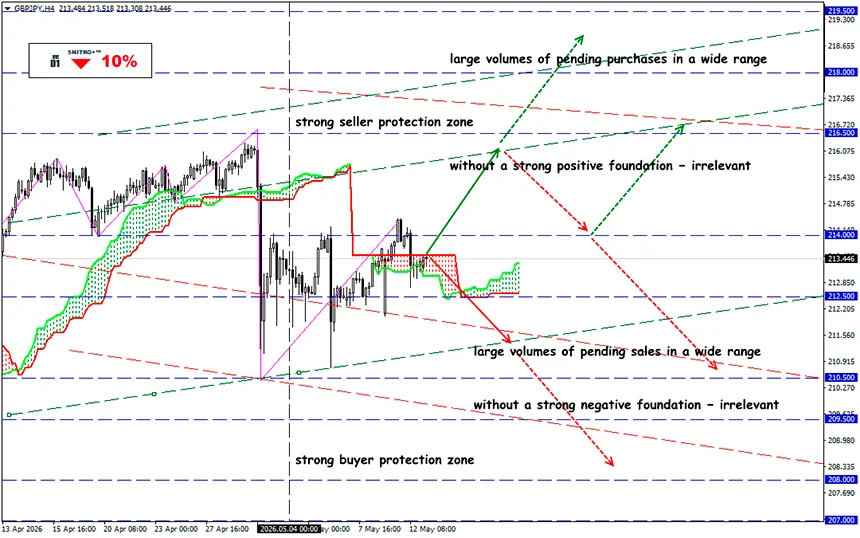
GBP/JPY
Key zone: 212.50- 214.00
Buy: 214.50 (on strong positive fundamentals); target 216.50-218.00; StopLoss 213.80
Sell: 213.50 (on a confident break of 214.00) ; target 211.50; StopLoss 214.20
The first visit by a U.S. president to China in nearly nine years has become one of the most important stress tests for the global economy. According to media reports and analytical centers, the agenda includes trade, tariffs, rare earth metals, high technologies, AI, Taiwan, and the Iran conflict.
U.S. objectives
- The White House needs an outcome that can be presented domestically as an economic victory: extension of the trade truce, increased purchases of U.S. agricultural products and aircraft, broader access for American businesses to the Chinese market, and reduced risk of a new tariff war.
- The U.S. aims to maintain leadership in AI, semiconductors, and technological standards while avoiding a full breakdown of global supply chains. The composition of the U.S. delegation, including major business and tech representatives, shows the visit is both diplomatic and industrial in nature.
- Trump must avoid allowing Iran, Taiwan, or sanction-related conflicts to derail economic stabilization. At the same time, he has not softened his rhetoric on Iran before the trip, despite this being one of the most sensitive areas of disagreement.
China’s objectives
- Beijing aims to cement its status as an equal global power center. China is interested in more predictable tariff policy, export restrictions, and technology access — but without concessions that would look like capitulation.
- Expectations for a “grand deal” remain limited; the most realistic outcome is temporary stabilization and the creation of conflict-management mechanisms.
- In the technological domain, China seeks to leverage its dominance in rare earth metals and industrial supply chains. Even after partial easing of U.S. restrictions, Washington remains highly dependent on Chinese rare earth supply.
- The Taiwan issue, not the trade deficit, remains the most dangerous potential “black swan” of the negotiations, with Beijing seeking at least minimal assurances that the U.S. will not accelerate support for Taiwanese independence.
What this means for Europe
For Europe, the visit could influence capital flows, the euro exchange rate, German export prospects, and overall risk sentiment toward European assets. The EU is particularly vulnerable to disruptions in logistics and global trade.
If negotiations deteriorate and tensions around Iran and the Strait of Hormuz escalate again, the European economy could be hit harder than the U.S.
A positive scenario would include an extension of the tariff truce, partial de-escalation of the tech conflict, and preserved trade channels. In that case, markets could shift into a global risk-on regime, meaning:
- lower demand for the U.S. dollar as a safe-haven asset;
- increased interest in cyclical currencies;
- recovery of carry trade strategies;
- capital inflows into European equities;
- improved expectations for European exports.
In such a scenario, EUR/USD could gain support even without active ECB action.
Reaction of Asian markets
For Asia, the visit is even more critical. The region is deeply tied to China through trade, rare earth supply chains, logistics, and dollar liquidity.
The most sensitive assets include the Chinese yuan, Hong Kong tech stocks, Taiwan, South Korea, and semiconductors. India and partially Japan appear relatively more stable.
Chinese and Hong Kong equities are likely to react first to the outcome of the meeting.
Ahead of the summit, Beijing allowed the yuan to strengthen to a three-year high: the People’s Bank of China fixed the rate at 6.8467 CNY per dollar, while the offshore yuan briefly moved below 6.8 for the first time since February 2023. This is interpreted as a signal of confidence and willingness to de-escalate.
A positive outcome would support the yuan, Chinese equities, and Asian currencies. A negative outcome would quickly return markets to expectations of a renewed tariff war.
What happens to commodities
Commodity markets react not only to headlines but also to expectations. Investors will assess not just final statements but also the likelihood of renewed trade confrontation, global crisis risks, or supply disruptions.
China remains the key driver of global oil demand growth, so positive signals for the Chinese economy could support Brent, WTI, LNG, and industrial metals. If both sides avoid escalation over Iran, part of the geopolitical risk premium could be removed from prices.
Gold remains the main safe-haven asset in case of failed negotiations, escalation of technological conflict, or dollar instability. Upside pressure on gold may emerge if:
- there is strong rhetoric on Taiwan;
- China hints at restrictions on rare earth exports;
- the U.S. expands sanctions policy.
An additional effect could be faster reserve diversification by central banks.
And what was the result?
The most likely scenario is an extension of the trade truce, a framework dialogue on tariffs, additional U.S. agricultural purchases, and possibly a mechanism for dispute resolution. This would not resolve structural U.S.–China rivalry but could reduce short-term risk premiums.
For markets, this is moderately positive for Chinese equities, Asian currencies, industrial metals, and U.S. agriculture. Gold would likely remain neutral to slightly negative.
The optimal scenario for investors is a managed truce. The worst-case scenario is a return of the “tariffs + Taiwan + rare earths” combination, which would sharply increase volatility.
For traders, this summit is not political theater — it is a high-risk event where discipline, position sizing, and fast scenario switching are critical. The base strategy remains: do not trade expectations before the final communiqué and always use stop-losses, as political headlines can reverse markets within minutes.
So we act wisely and avoid unnecessary risks.
Profits to y’all!