


Gold vs. Silver: who will win the battle for capital?
Volatility is shifting the balance of power in the market
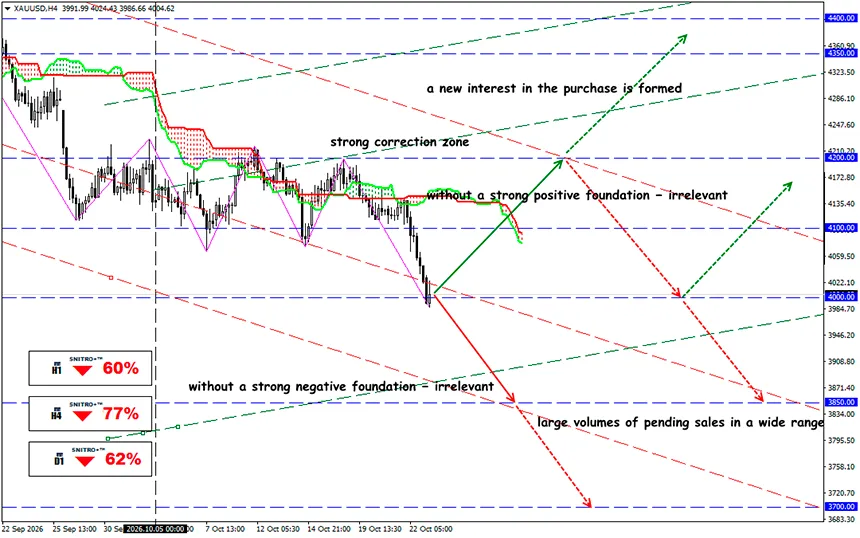
XAU/USD
Key zone: 3,950.00 - 4,050.00
Buy: 4,080.00 (on a strong positive fundamental basis); target 4,250.00; StopLoss 4,000.00
Sell: 3,950.00 (on a pullback following a retest of 4.0000); target 3,800-3,750; StopLoss 4,020.00
The correction in precious metals is once again raising a question for investors: why are returns diverging? Silver is losing its high-volatility advantage, but industrial demand could shift the balance of power in the precious metals market.
As of October 22, 2026, the precious metals market remains under pressure. The latest available COMEX trading data show significant declines in both assets.
Comparing gold and silver cannot be reduced solely to the depth of their corrections from all-time highs. Despite their high correlation, these metals serve different functions in the global financial system.
A quick recap:
- Gold remains primarily a monetary and reserve asset. Its value depends on real U.S. Treasury yields, the dollar exchange rate, geopolitical risks, central bank purchases, and investment flows.
- Silver combines the investment characteristics of a precious metal with those of an industrial commodity. Its price therefore also depends on manufacturing activity, electronics, solar energy, electrification, and technological demand.
- During periods of deteriorating economic expectations, gold generally enjoys more resilient fundamental support, while silver faces simultaneous pressure from investors and the industrial sector.
However, this does not mean that gold consistently outperforms silver. During an accelerating industrial cycle and rising demand for precious metals, silver can significantly outperform gold.
Since the beginning of the year, gold has outperformed silver by approximately 15.4 percentage points.
This divergence reflects differences in demand structure. Gold continues to benefit from reserve holdings and safe-haven investments, while silver reacts much more strongly to changing expectations for industrial production and the unwinding of speculative positions.
At the same time, silver's decline of more than 50% does not prove that physical industrial consumption has collapsed. Market prices are also influenced by liquidity, margin requirements, futures positioning, and investment flows.
The well-known Gold/Silver Ratio (GSR), based on published spot prices for October 21 — approximately $4,125.66 for gold and $57.48 for silver — stands at about 71.8.
A rising GSR indicates gold's relative outperformance, while a falling ratio indicates silver's. Unlike a directional position in a single metal, however, this indicator makes it possible to analyze the relative returns of the two assets even when the overall market is declining.
At present, the GSR does not show a confirmed, sustained uptrend over the short term. October's fluctuations indicate a struggle between buyers and sellers in the 70–74 range. For gold to establish a medium-term advantage, the ratio needs to break sustainably above 74–75. Otherwise, the possibility of a recovery in silver's relative value remains.
Pressure on precious metals is currently being sustained by rising U.S. bond yields, a stronger dollar, and uncertainty surrounding Fed decisions.
If high inflation is accompanied by slowing production, gold could benefit from demand for safe-haven assets. In this scenario, silver faces the additional risk of weakening industrial demand.
If, however, the Fed eases policy amid an economic recovery, declining real interest rates could support both metals, with silver potentially posting stronger percentage gains.
So What Is the Outcome?
Over the coming months, gold appears preferable to silver from a risk perspective. The reasons are clear: central bank demand, reserve diversification, and defensive investment flows provide support.
Silver retains the potential for a stronger recovery, but this scenario requires improving industrial conditions, reduced pressure from real interest rates, and a return of sustained investment demand. These developments will take time.
For medium-term positions, buying gold after a confirmed recovery above nearby resistance levels looks preferable to trying to pick a bottom in silver. However, a Fed shift toward monetary easing alongside a recovery in global manufacturing could quickly shift the balance in silver's favor.
So we act wisely and avoid unnecessary risks.
Profits to y’all!