


British debt vs. the pound
Can GBP/USD withstand the tax blow?
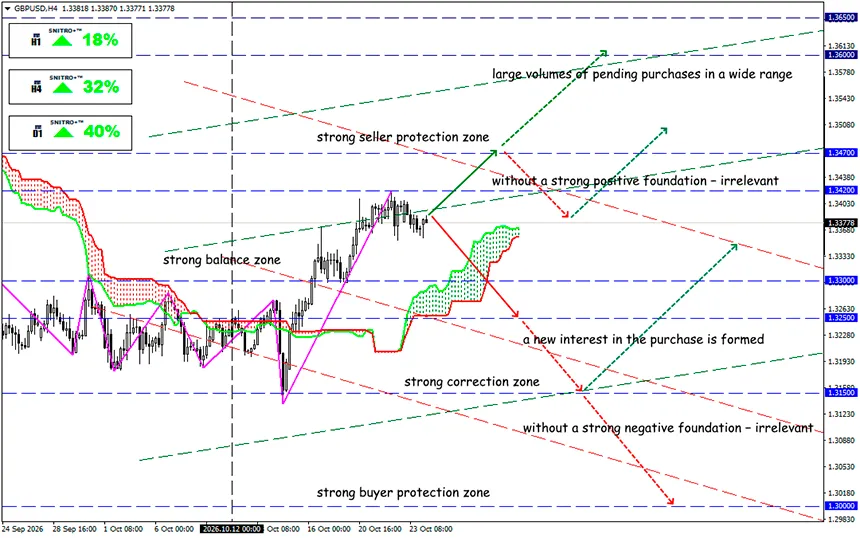
GBP/USD
Key zone: 1.3300 - 1.3400
Buy: 1.3420 (on strong positive fundamentals) ; target 1.3600-1.3650; StopLoss 1.3350
Sell: 1.3250 (on a pullback after retesting 1.3350) ; target 1.3100-1.3050; StopLoss 1.3320
London is looking for ways to strengthen public finances, but higher taxes threaten to slow the economy. The UK's Autumn Budget will test investors' confidence in the government's fiscal policy. For the pound, the decisive factors will be the bond market's reaction and the government's ability to keep borrowing costs under control.
High inflation, expensive government borrowing, and shrinking fiscal headroom are limiting London's options. Additional tax revenue could ease concerns about debt sustainability, but excessive fiscal tightening could weaken domestic demand and worsen the economic growth outlook. For GBP/USD, the outcome will depend on which of these effects proves stronger.
A quick recap:
On October 28, UK Chancellor of the Exchequer John Healey will present the Autumn Budget to the House of Commons. Following the statement, the Office for Budget Responsibility (OBR) will publish its updated Economic and Fiscal Outlook, covering forecasts for economic growth, inflation, government borrowing, and the debt burden through fiscal year 2031/32.
The central question is whether the government can stabilize public finances without increasing pressure on the economy amid high interest rates and energy-related risks.
For the currency market, the budget's significance is determined by three interconnected mechanisms.
- Budget revenue and government debt. If additional revenue convincingly reduces the need for new borrowing, the fiscal risk premium could decline. This could support the pound and ease pressure on the gilt market.
- Tax burden and economic activity. Higher payments by households and businesses could constrain consumption, investment, and corporate earnings. If the market considers the budget excessively restrictive, negative growth expectations could outweigh the benefits of deficit reduction.
- Inflation and BoE policy. Weaker domestic demand could slow core inflation and reduce the need for further monetary tightening. At the same time, higher indirect taxes could initially increase consumer prices, making the inflation outlook more difficult to assess.
The takeaway for traders: reducing the deficit will not necessarily strengthen the pound.
The budget will be presented just eight days before the Bank of England's November 5 meeting. Therefore, GBP/USD's reaction will depend not only on fiscal measures but also on how they affect interest rate expectations. In September, the central bank approved a multiyear plan to reduce its government bond portfolio, involving annual sales of £20 billion and an average annual portfolio reduction of approximately £46 billion through the end of 2034.
This balance sheet reduction maintains additional bond supply in the market, although actual yield movements also depend on investor demand, interest rate expectations, and the volume of new government borrowing.
The exchange rate's impact on the stock market will also be uneven. A weaker pound increases the sterling value of international companies' overseas revenue when converted into GBP, potentially supporting certain FTSE 100 constituents. However, companies primarily focused on the UK domestic market face different demand and financing conditions. Therefore, comparing the FTSE 100 with the more domestically sensitive FTSE 250 is useful for assessing the corporate sector's reaction.
So What Is the Outcome?
The UK budget could support the pound if investors see a realistic plan to stabilize public finances without causing excessive damage to economic growth. But even convincing deficit-reduction measures do not guarantee a GBP/USD rally: more hawkish Fed signals, a stronger dollar, or an increase in the UK's risk premium could offset the positive effect.
The base-case scenario ahead of the budget announcement is elevated GBP/USD volatility within the 1.3200–1.3500 range, with the risk of a directional breakout after new information becomes available. The technical picture moderately favors the pound, but resistance at 1.3400–1.3420 remains unbroken. For medium-term traders, it is more reasonable to wait for the OBR forecast, assess the gilt market's initial reaction, and then compare it with expectations for Fed policy.
Until these signals emerge, large directional positions carry elevated speculative risk.
So we act wisely and avoid unnecessary risks.
Profits to y’all!