










Analysts Expect Gold Below $4,000
Central Banks Are Buying Gold: Why Is the Market Falling?
XAU/USD
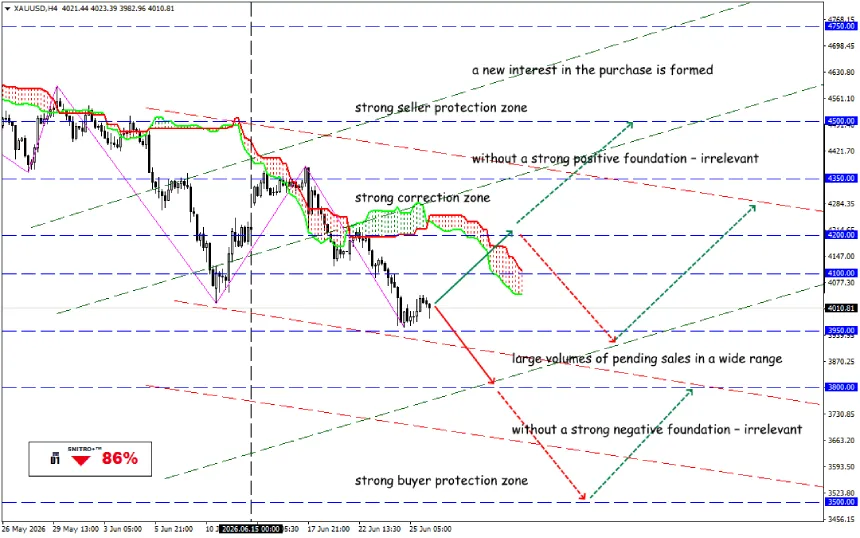
Key zone: 3,950.00 - 4,100.00
Buy: 4,100.00 (on a pullback after retesting 4,000); target 4,350-4,450; StopLoss 4,000.00
Sell: 3,900.00 (on strong negative fundamentals); target 3,650-3,500; StopLoss 4,000.00
The classic logic seemed unshakable: if official institutions are buying gold and the global reserve system is gradually moving away from absolute dependence on the U.S. dollar, then the yellow metal should inevitably rise. Unfortunately, a compelling long-term story does not always translate into a profitable trade today.
At the beginning of the year, gold had strong buy recommendations: central banks were increasing their reserves, China was trying to reduce its dependence on the dollar, geopolitical tensions were elevated, and inflation remained uncomfortably high. Price targets for gold in the $5,000–5,400 range appeared entirely reasonable.
Reminder:
Gold still has a strong argument in favor of further appreciation: the World Gold Council estimated net central bank purchases in the first quarter at approximately 244 tonnes. This is a very significant volume — demand for gold from the official sector has not disappeared. However, at the moment, this demand cannot overcome the combination of a strong U.S. dollar, high interest rates, and a hawkish Federal Reserve. Increasingly, the price is looking not upward, but downward — toward the psychological level of $4,000 per ounce.
The main question is no longer: Are central banks buying gold?
Within the reported 244 tonnes lies a small problem. Part of these purchases is fully transparent: countries officially report changes in their reserves, and the data can be verified by country, volume, and date. For example, among the largest buyers in the first quarter were Poland, Uzbekistan, and China. But another portion of demand is estimated by the World Gold Council using models, physical bullion flows, and undisclosed official-sector activity.
The market often turns an estimate into an absolute fact and then builds price forecasts worth thousands of dollars upon it. Central banks are not required to disclose every gold transaction immediately or in full — in some cases, the details may never be reported. Therefore, the 244-tonne figure represents the WGC's estimate of total demand, including both the visible and the undisclosed portions.
- Major players are not obligated to defend specific price levels. Gold is a reserve asset, a diversification tool, political insurance, and sometimes a source of liquidity. Central bank purchases can be a powerful long-term driver, yet provide only weak short-term support.
- When investors can earn attractive yields from U.S. dollar-denominated assets, holding gold becomes more expensive in terms of opportunity cost. If both Treasury yields and the U.S. dollar are rising simultaneously, the pressure on gold intensifies.
- When a country needs U.S. dollars, gold becomes a credit facility rather than a safe-haven asset. It can be pledged, utilized, temporarily removed from reserves, or converted into a source of liquidity. For example, Poland is buying gold because it is building a long-term reserve shield; Uzbekistan is increasing gold's share in its reserves; China is acting gradually and strategically; while Türkiye uses gold as a source of short-term liquidity.
This is not a single army of buyers. These are different countries facing different challenges. Central banks do not buy gold to rescue traders. If major players are indeed gradually moving away from the dollar's monopoly in global reserves, these purchases will not necessarily appear in official reports immediately.
And what is the result?
Recent experience proves that gold can remain a strategically strong asset while simultaneously declining for several consecutive months. In the short term, gold is being pressured by a highly toxic combination of factors: the U.S. dollar, Treasury yields, Federal Reserve policy, and military conflicts.
That is why gold can decline despite favorable long-term news. The market today is not voting on political narratives or long-term valuation stories — it is pricing the real cost of money.
As long as the DXY remains above key technical levels and the market continues buying the U.S. dollar on expectations of a hawkish Federal Reserve, gold will struggle to establish a sustainable uptrend. Holding long positions in gold under such conditions means trading against a powerful macroeconomic trend.
So we act wisely and avoid unnecessary risks.
Profits to y’all!