










Walmart: a new member of the elite club
Retailer walmart is now worth $1 trillion
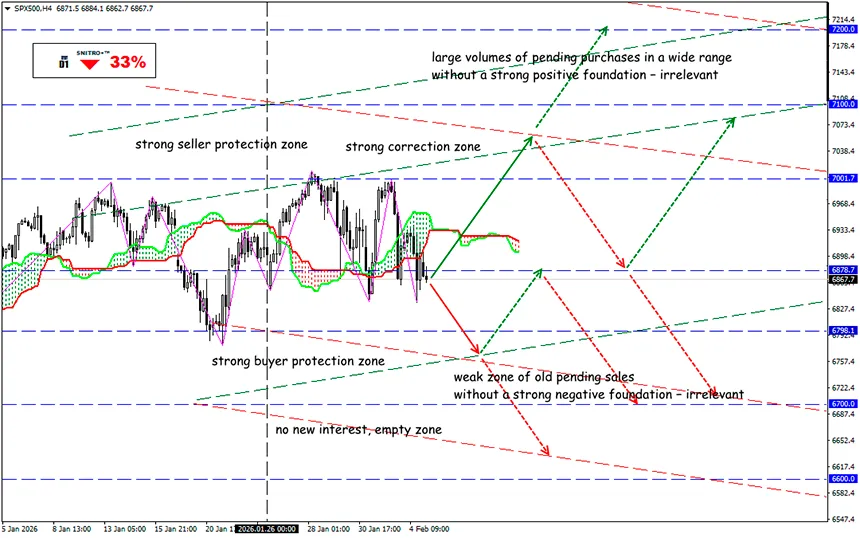
SP500
Key zone: 6,850 - 6,900
Buy: 6,900 (on strong positive fundamentals); target 7,050-7,150; StopLoss 6,830
Sell: 6,800(on a pullback after retesting 6,850); target 6,650; StopLoss 6,860
Walmart Corporation has reached a market capitalization of $1 trillion, becoming one of the few companies outside the technology sector to cross this threshold. Previously, only Berkshire Hathaway had achieved a similar result. The growth in valuation was the result of a radical revision of the business model and a large-scale digital transformation.
The largest US retailer has consistently repositioned itself as a technological platform, actively investing in digital advertising, data analytics, and artificial intelligence projects. Essentially, Walmart today represents an omnichannel ecosystem with strong IT infrastructure. The increase in share price by about 26% over the year confirms that the market positively assesses the effectiveness of this strategy.
Key elements of the transformation:
- Walmart was one of the first among traditional retailers to make a systematic bet on AI and carried out a comprehensive digital restructuring of operational processes.
- The company entered into strategic partnerships with OpenAI and Google, integrating its online shopping tools into search and conversational services, which strengthened control over the entire customer journey — from product search to order placement.
- The retailer managed to expand its customer base by attracting higher-income consumers while maintaining loyalty among its core low- and middle-income audience.
- Over the past five years, Walmart scaled its marketplace to more than 500 million product listings, introduced express delivery, launched the Walmart+ subscription as an alternative to Amazon Prime, and built an advertising business with annual revenue exceeding $4 billion.
The next strategic benchmark for management is to increase operating margin above 6%. The company has not demonstrated such levels since 2015. In fact, investors have already priced into the current capitalization expectations of the effect from AI implementation and expansion of the advertising segment, where margins reach 60–80%. Thus, the market has granted Walmart an advance of trust in future efficiency.
However, this credit of expectations may be partially offset by macroeconomic risks. A global economic slowdown and weakening of the US labor market increase pressure on consumers. Households with low and middle incomes are already facing a decline in real incomes amid persistent inflation and slowing employment growth.
Nevertheless, the historical demand model continues to work in the company’s favor: during periods of economic uncertainty, consumers tend to increase their focus on discount retail. In this sense, Walmart remains a beneficiary of a savings strategy tested by several generations of buyers.
At the moment, the US stock market is showing attempts at recovery. The S&P 500 tested local support near 6,885 points and retains the potential to return to the 6,900–7,000 range. Nasdaq 100 futures returned to growth after two days of sell-offs in the technology sector amid a reassessment of corporate earnings.
Walmart is a clear example of how investments in a single company can deliver higher returns compared to investments in the broad market. For almost two years, the retailer has consistently outperformed the S&P 500. Under current conditions, the company is gradually forming the status of a universal defensive asset, relatively resilient to internal risks, instability of US governments, energy speculation, and foreign policy threats.
So we act wisely and avoid unnecessary risks.
Profits to y’all!