










The Fed Chooses the Pace: Two Main Scenarios
What to Expect from the Federal Reserve
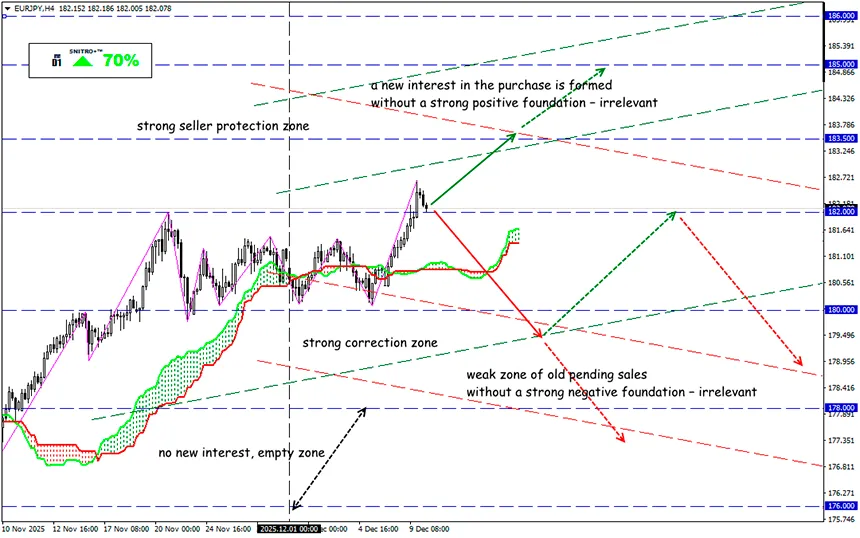
EUR/JPY
Key zone: 181.50 - 183.00
Buy: 183.00 (on strong positive fundamentals) ; target 184.50-185.50; StopLoss 182.30
Sell: 181.00 (on a confident breakout of the 181.50 level) ; target 180.00-178.50; StopLoss 181.70
The U.S. regulator is summarizing the results of the final meeting of 2025 — a decision that will determine the dollar’s trajectory for the coming months. Despite internal disagreements within the FOMC, it is necessary to define an optimal pace for further policy easing.
The statistical vacuum after the shutdown has seriously complicated the regulator’s work: there is virtually no up-to-date information on the state of inflation or the labor market. The employment situation looks particularly troubling: tighter immigration rules are reducing labor supply, and tariff policy does not help improve job quality. As a result, unemployment will almost certainly continue rising in 2026.
At the same time, the basic outcome of the meeting is essentially predetermined. According to CME FedWatch, the probability of a 25 bp rate cut reaches 97%. That means the fact of the rate cut has long been priced in, and subsequent market reaction will depend entirely on Powell’s rhetoric and the nuances of the accompanying statement.
The further trajectory of easing remains unclear. Essentially, the Fed has only two options:
- cut the rate to stabilize the labor market;
- hold the rate to maintain pressure on inflation.
And proponents of both approaches have strong arguments.
On the side of the “optimists” — weak macro data:
- ISM manufacturing index decline to 48.2;
- sluggish retail-sales growth (+0.2%);
- minimal consumer-confidence readings (88.7);
- a disputed labor-market report with unemployment rising to 4.4%.
On the side of the “moderate pessimists” — inflation, which remains above target but shows signs of slowing:
- September CPI grew 3.0% (vs. the 3.1% forecast);
- core CPI also slowed to 3.0%;
- the new-orders index fell from 56.2 to 52.9 in November.
If the Federal Reserve accelerates the rate-cutting cycle, other regulators — the ECB, BOE, Bank of Canada — will have to take similar steps to preserve export competitiveness.
The Fed is unlikely to provide direct guidance on the timing of the next rate cut, but the focus of its rhetoric will likely shift toward labor-market risks and weakening economic momentum.
And most importantly: President Trump is openly pressuring the Federal Reserve, demanding rate cuts to 1% and the fastest possible economic acceleration before the end of his term. This pressure will only intensify, and the identity of the next Fed Chair does not matter in this process.
What will follow — a new wave of inflation or a double recession — is not critical for the current U.S. administration. The key is that the market sees a short-term economic effect.
So we act wisely and avoid unnecessary risks.
Profits to y’all!