










Saylor Is Ready to Sell Bitcoin: Is a Catastrophe Already Near?
Strategy Admits the Possibility of Asset Sales
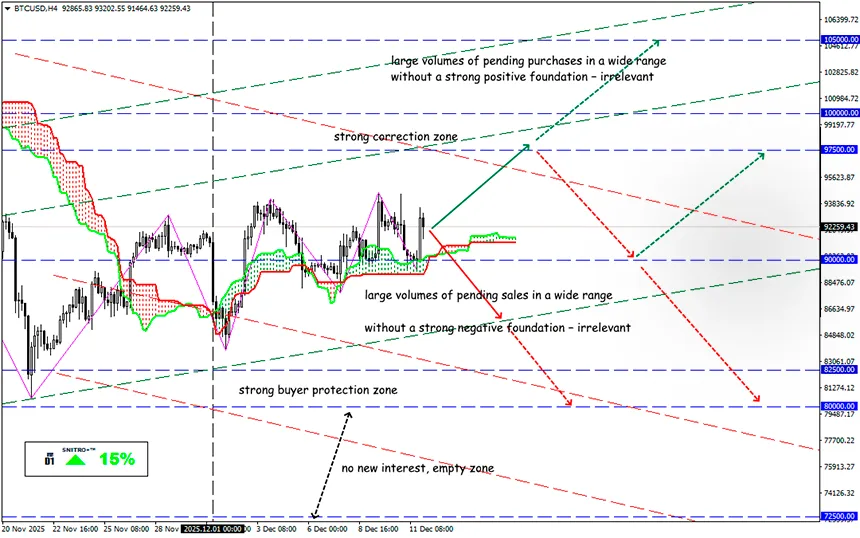
BTC/USD
Key zone: 88,500 - 91,500
Buy: 93,500 (on strong positive fundamentals) ; target 98,500-100,000; StopLoss 92,500
Sell: 87,500 (on a confident breakout of the 90,000 level) ; target 83,500; StopLoss 88,500
The market clearly remembers Michael Saylor’s repeated statements that Strategy would “never sell” the bitcoins accumulated on its corporate balance sheet. However, this week the largest public holder of BTC stated that it does not plan to sell assets only until … 2065. The wording looks strange, but the key point lies elsewhere: this date is not final and can be revised if necessary.
Why has the company effectively stepped away from the concept of perpetual HODL, and what has changed in its financial model?
Recall:
The Digital Asset Treasuries (DAT) model was developed by Saylor himself. Its essence lies in using the corporate balance sheet for systematic cryptocurrency purchases while market capitalization and share prices grow faster than the underlying token. From late 2023 to mid-2025, this scheme appeared almost flawless: more than a hundred companies in the US and Canada began copying Strategy’s approach.
In the first half of 2025, DAT companies were in a phase of outright euphoria. A striking example is SharpLink Gaming, whose shares at the peak surged by roughly 2,600%.
Then the core problem became evident: digital assets do not generate operating (real) cash flow. Almost all DAT companies acquired cryptocurrencies using borrowed funds. When the crypto market entered a phase of high volatility, many of them lost the ability to service their debt obligations.
The average decline in DAT company valuations amounted to around 43%, while some stocks collapsed by 90–99%. The corporate BTC-treasury model ceased to be a growth bet and turned into a function of debt burden, risk-management quality, and the ability to raise capital on a regular basis.
The $1.44 billion liquidity reserve created by Strategy to service its debt covers the problem only for the next few years. This is precisely why Strategy’s CEO Phong Le publicly admitted, for the first time, the possibility of selling BTC from the corporate balance sheet.
Despite Saylor’s ambitions, the market demands financial transparency and a realistic sustainability model. Strategy can no longer declare constant buying and infinite holding of assets for several reasons:
- debt obligations require regular cash payments;
- the market has matured and no longer reacts to promises without a proven financial base;
- the presence of a formal date increases trust among investors and creditors.
The potential sale date — 2065 — primarily serves a legal and psychological function: it is designed to stabilize expectations of shareholders and debt holders. However, in the short term the market reacted nervously: some participants perceived the statement as a signal of imminent sales and began to panic.
Strategy’s financial stability remains a key factor for BTC’s short-term dynamics. If the mNAV ratio (currently around 1.13) falls below one, the market will start pricing in the risk of forced bitcoin sales. Such a scenario could trigger cascading sell-offs and intensify pressure across the entire crypto sector.
If, however, the company manages to maintain balance without forced asset liquidation, this will become an important signal of resilience for the market.
How successfully Strategy adapts to changing economic conditions, debt load, and investor expectations will determine BTC dynamics in the near future and influence the entire digital-asset industry.
So we act wisely and avoid unnecessary risks.
Profits to y’all!