










How Scott Bessent is breaking the old forex
The U.S. is dictating exchange rates to its allies
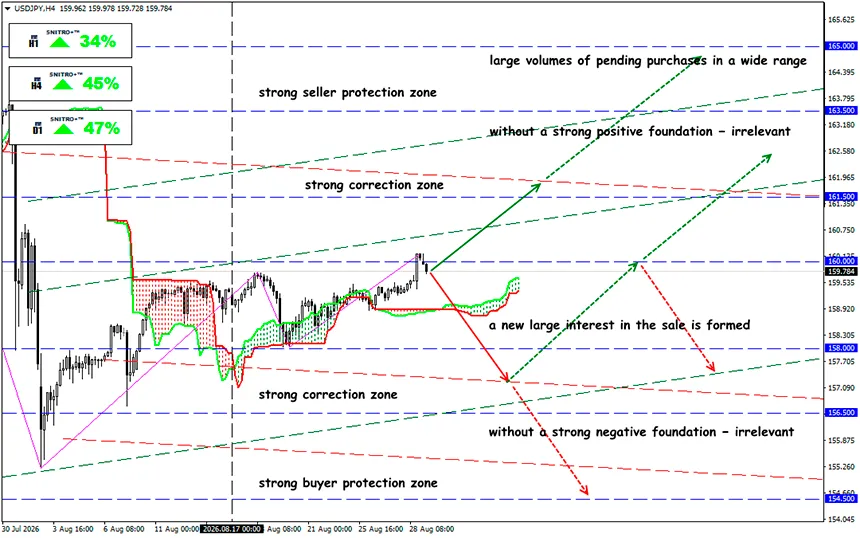
USD/JPY
Key zone: 159.00 - 160.50
Buy: 160.80 (on strong positive fundamentals) ; target 162.50-1.63.50; StopLoss 160.20
Sell: 159.00 (on a confident break of 159.00) ; target 157.50-156.50; StopLoss 159.70
The global currency system is entering a dangerous phase. Washington is no longer willing to tolerate exchange rates it considers unfavorable to the U.S. The Treasury is moving from diplomatic statements to direct financial pressure.
Washington is no longer an observer: the U.S. has shown that it is prepared to buy another country’s currency using its own reserve resources if that currency’s decline begins to threaten financial stability.
Until recently, the idea of direct U.S. Treasury intervention in the foreign exchange market of a major trading partner seemed almost impossible. Now it has become a reality.
A reminder:
The joint U.S.-Japan intervention on July 31 set a precedent that the market can no longer ignore. The yen was trading around ¥164 per dollar, after which Washington intervened in the market together with Tokyo. Bessent later said that the U.S. was prepared to do “whatever is necessary” to stabilize the yen.
This is no longer just talk about currency policy. Moreover, Washington’s argument was exceptionally broad: Bessent directly linked the yen’s sharp decline to the risk of forced position unwinding and global financial instability.
And this raises the key question: who determines what kind of currency decline is “disorderly”?
The answer is obvious — whoever has the ability to intervene.
That is precisely why discussions about a “Bessent Doctrine” matter even without an official document. This is not about giving currency policy a new name. It is about the emergence of a new mechanism of pressure.
The Yen Is Only the First Test
Japan became the first battleground, but the problem is much broader. A weak national currency gives exporters a competitive advantage, supports a trade surplus, and simultaneously increases the cost of U.S. imports.
If Washington considers such an exchange rate artificially undervalued, it now has several levels of pressure at its disposal:
tariffs → negotiations → pressure on the central bank → currency intervention.
This is already a full-fledged arsenal of economic weapons. And most dangerously, the market now knows that the threat of intervention may not be an empty warning. Traders will have to forget the old rules.
USD/JPY
Buying the dollar against the yen at extreme levels is no longer a conventional bet on the interest rate differential. After the joint operation, the yen weakened again: by the end of August, the dollar approached ¥160, while Bessent said that current movements still appeared controlled. But the very fact that the pair has returned to the critical zone demonstrates the limitations of a single intervention.
Consequently, the trader is not only buying carry. At the same time, the trader is effectively selling the yen an “option” on government intervention.
The higher USD/JPY rises, the more dangerous this trade becomes.
EUR/USD
If Washington really begins promoting a managed revaluation of currencies, betting exclusively on dollar weakness could also become a trap. The euro may rise not because the European economy is becoming stronger, but because the market is pricing in political pressure on the dollar.
And a political premium disappears much faster than it emerges.
USD/CNY
This is where the real war begins. The yuan is the key strategic test for the new U.S. policy.
If Washington moves from pressuring Tokyo to demanding a sustained appreciation of the CNY, this would represent an entirely different scale of conflict.
China Is Not Japan.
Beijing is under no obligation to accept U.S. demands, and an attempt to change the yuan’s exchange rate would affect the cost of Chinese exports, the U.S. trade balance, capital flows, and global supply chains. The main threat is a currency war without officially declaring a currency war.
The U.S. does not necessarily need to formally abandon its strong-dollar policy.
It only needs to do something else: choose which currencies should appreciate.
That is much more effective.
- If the yen is too weak — Washington helps strengthen it.
- If the yuan is too cheap — pressure on Beijing begins.
- If a trading partner offsets tariffs through currency devaluation — currency policy becomes part of the trade war.
As a result, Forex is transforming from a market where currencies primarily react to interest rates and economic data into a market where political directives must also be taken into account.
Bessent Has Already Shown That He Is Prepared to Go Further
It is particularly significant that after the intervention, Bessent did not retreat from the idea of supporting Japan. He allowed for further support and advocated a more active role for the BOJ in strengthening the yen.
At the same time, Japanese bond yields remain under pressure, while the market expects further BOJ policy tightening.
In other words, Washington is effectively pushing Tokyo toward a combination of:
stronger yen + higher interest rates + less currency pressure.
This is no longer an ordinary request to an ally. It is economic coordination under U.S. pressure.
So, What Does This Mean?
For now, the “Bessent Doctrine” remains an analytical term rather than an officially announced new currency regime. But the market has already received proof of the key point: the U.S. Treasury is capable of entering the foreign exchange market and changing the balance of power.
And that changes the rules of the game. It is no longer enough for a trader to know the Fed rate, inflation, payrolls, or yield differentials.
Traders also need to know which exchange rate Washington considers too low.
If this practice spreads from JPY to CNY, the market will face an entirely new Forex architecture. Interest rate differentials will remain important, but they will be accompanied by the political risk of intervention.
And political risk cannot be traded using classical models. It simply appears the moment an official pushes the button.
The key signal for the coming months is China.
If the U.S. begins seeking a revaluation of the yuan using the same methods it is currently using to pressure the yen, this will mark the definitive transition from currency diplomacy to managed Forex.
And then traders will have to trade not only against central banks.
So the key issue is not whether the dollar falls or rises, but the emergence of Washington’s ability to effectively determine the “acceptable” exchange rate of another country’s currency. At the same time, current data show that the yen itself has once again approached ¥160, meaning that a single intervention cannot solve the problem.
So we act wisely and avoid unnecessary risks.
Profits to y’all!