




Norway’s oil fund: a record does not eliminate risk
Don’t confuse index-driven success with managerial genius
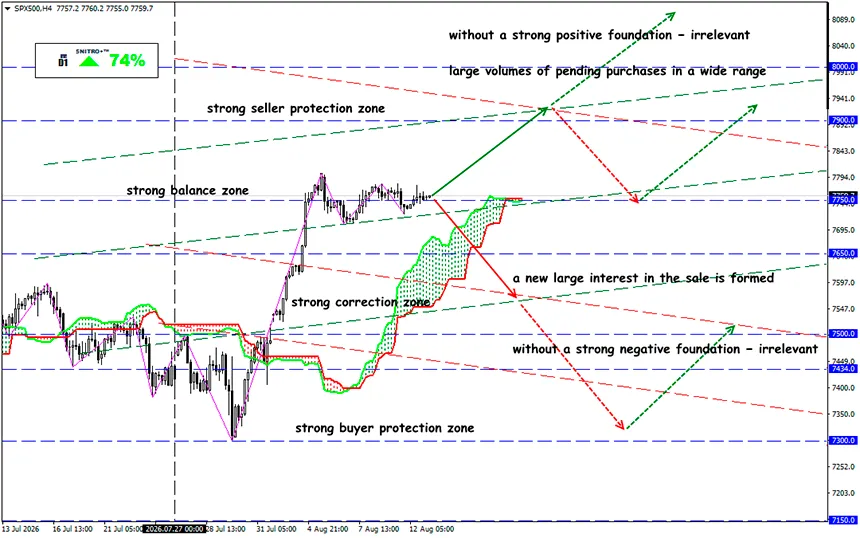
SP500
Key zone: 7,700 - 7,820
Buy: 7,850 (after retesting 7,800); target 8,000-8,050; StopLoss 7,800
Buy: 7,850 (after retesting 7,800); target 8,000-8,050; StopLoss 7,800
Norway demonstrates something that very few governments manage to achieve: oil revenues do not have to be simply spent — they can be transformed into global capital that works for decades. But the main lesson of Norway’s oil fund is not its record profit in 2026. It is the system that allows the government to avoid interfering with professional managers as they generate returns in global markets, while maintaining strict control over the rules of the game.
This is where the fundamental difference lies between government investing and direct government micromanagement of the market.
A reminder:
Norway’s Government Pension Fund Global, managed by Norges Bank Investment Management (NBIM), returned 9.4% in the first half of 2026, while investment profit reached NOK 1.753 trillion — about $184 billion. The result is genuinely exceptional. For comparison, the fund returned 15.1% for the full year 2025, while its annualized return since its inception in 1998 is around 6.6%.
But it is important not to fall into the trap of an impressive headline number.
NBIM did not simply pick a few winning stocks and turn government money into extraordinary profits. The fund primarily generates returns from movements in the global market. Its strategy is built around broad diversification and limited deviation from its benchmark index. The record profit is the result of an efficient management system combined with powerful growth in global markets.
The fund’s greatest strength is not stock picking, but the fact that it does not need to guess which stocks will win. The fund was created to invest Norway’s oil and gas revenues for the long term. The Ministry of Finance defines the overall investment mandate, while NBIM is responsible for professional asset management.
The money is invested predominantly outside Norway. This allows the fund to accomplish two objectives simultaneously: generate returns from the global economy and avoid overheating the domestic economy with massive internal investments. NBIM itself explicitly states that the fund invests only abroad precisely to protect the Norwegian economy from overheating.
At the end of the first quarter of 2026, equities accounted for 70.2% of the portfolio, bonds for 27.6%, unlisted real estate for 1.8%, and renewable energy infrastructure for 0.4%.
At the same time, the fund remains a global investor with an enormous number of positions. Its average ownership stake in publicly listed companies worldwide is around 1.5%. At the end of 2025, the portfolio held shares in approximately 7,200 companies.
In other words, Norway is not trying to guess the next Nvidia — it is buying the global market itself.
The strong result in 2026 is largely linked to the technology rally and gains among semiconductor manufacturers. The fund’s major holdings include Nvidia, Apple, Alphabet, Microsoft, and Taiwan Semiconductor Manufacturing.
At the end of 2025, Nvidia was already the fund’s largest individual position, with a combined value of shares and bonds of around NOK 576.6 billion. It was followed by Apple, Microsoft, Alphabet, and TSMC.
Therefore, it would be wrong to claim that the record result was created entirely by NBIM’s management skill.
The fund benefited enormously from the fact that the global market once again rewarded technological growth.
So, what does this mean?
Norway’s oil fund genuinely deserves attention, but not as a story about “genius investing.” It is a story about discipline.
The strongest aspect of the Norwegian model is not even in the portfolio. It lies in the separation of responsibilities. The government controls the rules, not every individual trade. The government defines the strategy and restrictions. The professional asset manager is given room to make investment decisions. As a result, the government controls systemic risk rather than trying to tell the manager every day which stock to buy.
Norway allows its oil revenues to work for future generations instead of disappearing into current budget expenditures. The manager has been given a clear mandate. The portfolio is globally diversified. Individual company risk is limited. The domestic market is protected from excessive capital inflows. And temporary losses do not become a reason for panic-driven decisions.
This is far more effective than attempts to turn a sovereign fund into a political instrument.
So we act wisely and avoid unnecessary risks.
Profits to y’all!