










Oil on the blockchain: a standard of the commodity market
Can “Digital oil” change the trade of energy resources?
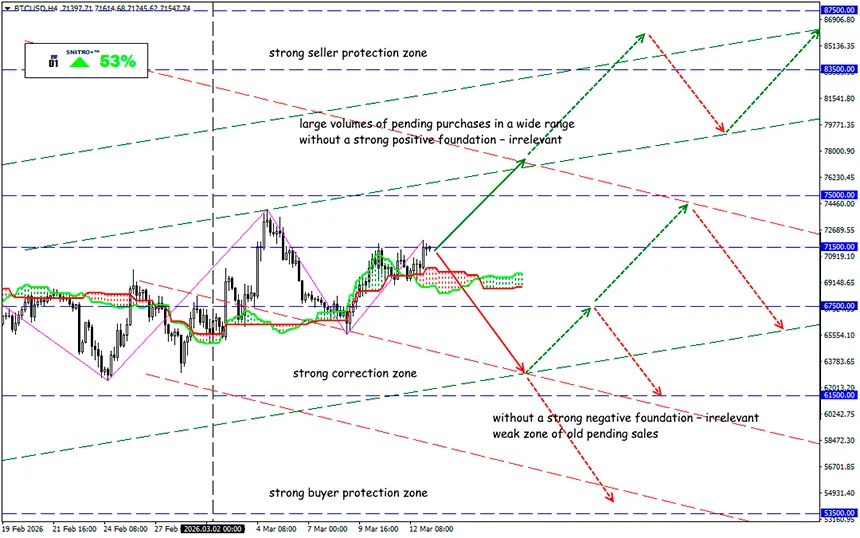
BTC/USD
Key zone: 67,500 - 73,500
Buy: 75,000 (on strong positive fundamentals) ; target 78,500; StopLoss 74,000
Sell: 67,500 (on a confident breakout of 68,500) ; target 63,000-61,500; StopLoss 68,500
The digitalization of financial markets is gradually moving beyond traditional assets and spreading to real physical resources. One of the most promising directions is the tokenization of commodity goods (RWA), and oil is considered one of the most convenient assets for such a transition.
Reminder
Tokenized oil is a digital asset created on the basis of blockchain that reflects ownership rights or the economic value of physical oil or revenues from its extraction. The value of such tokens is directly linked to the market price of the raw material.
According to estimates by industry analysts, by 2026 the volume of the tokenized oil market may reach approximately $500 million, making it one of the most notable segments among tokenized energy assets.
- At the current stage, such tokens are usually backed by physical oil: one token corresponds to a specific number of barrels. The actual volumes of raw materials are stored in warehouses or tanks of verified suppliers who confirm the existence of physical reserves. A token may record rights to production, revenues from a field, or a share in an extraction project.
- Pricing is tracked through smart contracts or via derivative financial instruments.
- Both public and corporate blockchain networks are used for the issuance and circulation of oil tokens — such as Ethereum, Solana, XRP Ledger and Hedera. These technologies ensure immutability of records, transparency of ownership, and global access to assets. As a result, the entry threshold is reduced and access for retail investors is expanded.
- “Digital oil” may be traded similarly to crypto assets — around the clock and without the limitations of traditional exchange sessions on global digital platforms.
- In the long term this may lead to the emergence of decentralized global oil trading venues, the tokenization of state oil reserves, and the integration of commodity markets with the infrastructure of Decentralized Finance.
New models of capital attraction
Tokenization opens additional financing opportunities for oil projects.
- Tokenization of extraction — the issuance of tokens backed by future revenues from the development of a field.
- Tokenized funds — the issuance of tokens backed by a portfolio of oil assets.
- On certain crypto platforms, tokenized oil markets are already demonstrating noticeable trading volumes.
Examples of projects
PetroCoin
A project in the format of a security token aimed at the tokenization of proven oil and gas reserves. The token is implemented in the ERC-20 standard based on the Ethereum network and is backed by oil and gas reserves, production revenues, and related energy assets.
OilChain
A platform for the tokenization of oil assets through the Security Token Offering (STO) model. The main objective of the project is to create an infrastructure bridge between the traditional oil sector and digital financial markets.
Zoniqx / One World Petroleum (OWP)
One of the first tokenized oil funds operates on the Hedera blockchain. The platform offers tokenized shares in oil assets as well as lending instruments for industry operators.
Chevron Energy Tokenization Ecosystem
Platforms of this type are focused on tokenizing oil reserves, creating digital trading venues, and introducing automated smart contracts into trading and settlement processes.
And what is the result?
The widespread adoption of tokenized oil requires solving a number of institutional and technological issues. Among the key questions are regulatory restrictions, confirmation of backing by a physical asset, and the standardization of infrastructure.
International regulators also point to a number of tokenization risks: potential legal disputes over ownership rights, counterparty risks, and the complexity of integration with cryptocurrency markets. The functioning of such systems requires regular audits and a transparent legal structure.
An additional factor remains the double volatility of such instruments: they are simultaneously exposed to fluctuations of both the oil market and the cryptocurrency segment.
At the same time, long-term forecasts indicate significant potential for tokenization. According to analysts’ estimates, the total market for tokenized assets may reach $16–24 trillion by 2030.
At the same time, digital commodity trading systems may face scalability problems, cyber threats, and dependence on blockchain infrastructure.
In the long term, the tokenization of oil may become one of the stages in the transformation of global commodity markets. However, its practical development will depend on the combination of technological innovations, institutional reforms, and the evolution of market mechanisms.
So we act wisely and avoid unnecessary risks.
Profits to y’all!