










How SpaceX is stealing money from the crypto market
BTC lost the battle for capital
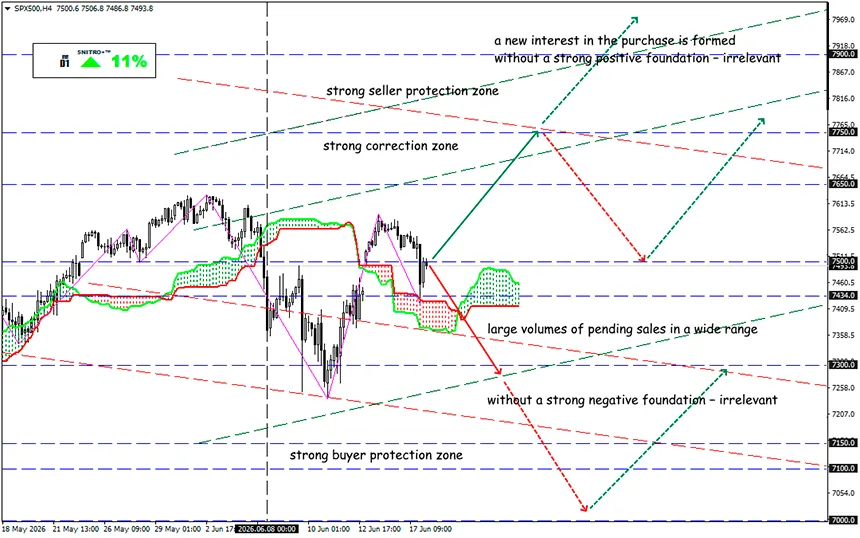
SP500
Key zone: 7,450 - 7,550
Buy: 7,600 (on a pullback following a correction to 7,500); target 7,850; StopLoss 7,530
Sell: 7,400 (on strong negative fundamentals); target 7,200-7,150; StopLoss 7,470
The rapid rise of SpaceX shares after its public listing is forcing investors to take a new look at capital allocation between traditional technology companies and digital assets. In just eight trading days after the IPO, the company’s market capitalization exceeded $2.5 trillion, while its shares gained more than 40%.
At one point, SpaceX’s valuation was almost twice the market capitalization of Bitcoin. However, the key question is not the comparison between the two assets, but the redistribution of the most valuable resource in today’s market — venture capital. This is where the real competition is unfolding today.
Reminder:
SpaceX has long ceased to be purely a space company. After acquiring xAI, Elon Musk’s business combined space technologies, artificial intelligence, and large-scale computing infrastructure into a single ecosystem. The integration of Grok models and its own data centers effectively turned the company into a direct competitor to OpenAI and Anthropic.
Any mature market develops through three key resources:
- liquidity;
- human capital;
- venture investment.
From 2015 to 2024, the cryptocurrency industry held leading positions across several areas at once.
- The best engineers actively moved into Web3 projects.
- Venture funds created specialized divisions for investing in digital assets.
- Hundreds of billions of dollars were directed toward the development of cryptocurrency infrastructure.
However, over the past few years, the industry has faced a fundamental problem: it has stopped creating unique investment stories. Most new projects are merely variations of existing models. Against this backdrop, Bitcoin is increasingly perceived as a passive asset that can preserve value but does not generate new cash flows.
For institutional investors, this is a fundamental difference.
A large-scale redistribution of global venture capital is beginning today. This is not about retail investors’ money or ETF liquidity, but precisely about the resource that fueled the explosive growth of the entire cryptocurrency industry over the past fifteen years.
At the same time, SpaceX offers the market several major directions at once:
- space logistics;
- global satellite communications;
- artificial intelligence;
- defense technologies;
- next-generation data center infrastructure;
- robotics;
- energy infrastructure.
In effect, the company combines all the future-oriented ideas on which the investment appeal of the crypto market had been built for many years. This synthesis of technologies is becoming a powerful signal of where risk capital and investor attention are now beginning to flow.
For venture funds, such a model looks significantly more attractive than most existing crypto projects.
And what is the result?
The main risk is that current market expectations have already reached extremely high levels, leaving minimal room for error. A SpaceX failure could affect not only the technology sector but also a broad range of private investors and large funds.
The financial figures also require caution:
- at the end of 2025, SpaceX posted a net loss of $4.94 billion;
- revenue reached $18.67 billion;
- with a market capitalization of around $2.5 trillion, the P/S multiple exceeds 130, which some analysts are already calling “meme-stock” territory.
It is time to stop thinking in terms of “stocks versus crypto.”
Today, SpaceX is not just another loud IPO. If earlier the market tried to answer the question of how much Bitcoin would be worth in ten years, now it is increasingly asking a different question: which company will own the key infrastructure of human civilization in the next decade?
The winner is not the one who shouts the loudest about the future. It is the one who manages to build that future. And today, big capital is betting on Elon Musk.
So we act wisely and avoid unnecessary risks.
Profits to y’all!